


A 4K resolution sticker on a retail box doesn't guarantee your property is safe; in fact, a low-quality 8MP sensor often captures less detail at night than a professional-grade 6MP unit. It's easy to feel overwhelmed by the technical jargon of modern cctv systems, especially when you're trying to avoid the trap of buying outdated analog technology or unreliable wireless gear. You want a system that works every time, providing clear evidence rather than a blur of pixels when it matters most.
We understand that you need a surveillance solution that offers professional intelligence and total control over your Australian property. This guide simplifies the complex technical landscape, showing you exactly how to differentiate between cheap consumer hardware and the robust, long-term value of professional equipment. You'll gain a clear blueprint for a system designed to remain effective through 2030. We'll examine the core components of modern networks, the truth about wired versus wireless reliability, and how to choose hardware that provides genuine peace of mind for your home or business.
Key Takeaways
- Understand the transition from grainy analog footage to ultra-high-definition IP networking for crystal-clear property surveillance.
- Identify the critical hardware roles of the camera and NVR to ensure your system functions as a cohesive, intelligent brain for your security.
- Learn how AI-driven analytics in a modern cctv system filter out 90% of false alarms, providing you with high-accuracy alerts that matter.
- Master the art of surveillance layout design by calculating focal lengths and conducting professional-grade vulnerability assessments of your perimeter.
- Discover why Australian-authorised stock and local technical support are vital for maintaining a reliable system that outlasts standard retail kits.
What is CCTV in 2026? The Evolution of Digital Surveillance
The definition of What is CCTV has changed fundamentally over the last decade. In 2026, it no longer refers to a simple "closed" loop of localized wiring. Modern cctv systems are now sophisticated nodes on an Internet Protocol (IP) network. We've moved beyond the era of grainy, flickering 420TVL analog footage that was common in the early 2000s. Today, ultra-high-definition 4K digital streams provide forensic-level detail. This technological leap allows Australian property owners to identify faces and number plates with high precision from distances that were previously impossible to monitor. Active AI alerting has replaced the old model of passive recording. Older systems required someone to watch a monitor or review hours of footage after a crime occurred. Current 2026 standards utilize deep learning algorithms to distinguish between a swaying tree branch and a human intruder. This shift means your system acts as a proactive security guard. It sends real-time notifications to your device the moment a genuine threat is detected. This intelligence reduces false alarms by over 80% compared to basic motion detection sensors used five years ago.The Core Purpose of a Modern Security System
Deterrence remains the first line of defense for any Australian home or business. Visible, high-quality cameras signal to potential intruders that a property is a hard target. Statistics from the Australian Institute of Criminology consistently show that properties with visible surveillance see a marked reduction in opportunistic crime. Beyond deterrence, modern systems provide critical evidence. High-resolution 8MP footage is now a standard requirement for Australian legal proceedings and insurance claims. Remote management has become a non-negotiable feature for the modern user. Dedicated smartphone apps provide instant access to live feeds and recorded events. You can manage your security settings, trigger audible alarms, or speak through two-way audio components from anywhere in the world. This level of connectivity ensures you have total visibility whether you're at the office or travelling interstate.Analog vs. IP Systems: Why Digital Wins
The Anatomy of a Professional CCTV System
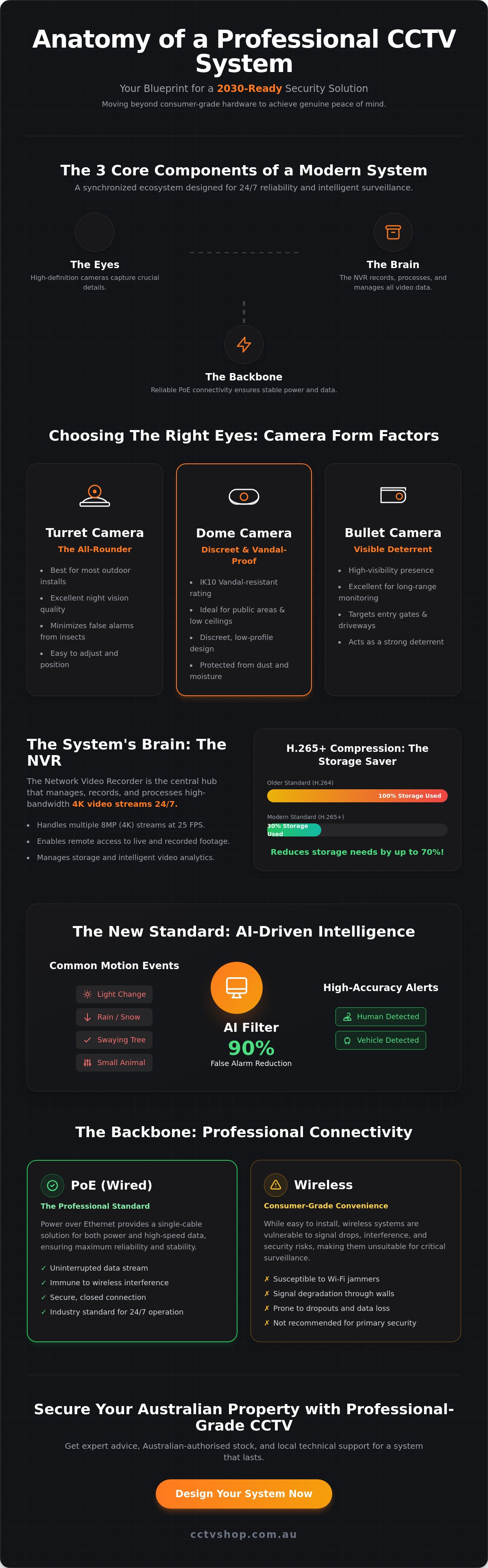
A professional cctv system is a synchronized ecosystem designed for 24/7 reliability. It isn't just a collection of lenses; it's a sophisticated network where every component must be selected based on the specific environment, whether it's a coastal residential property or a high-traffic retail space in Sydney. Understanding the hardware ensures you don't overspend on features you don't need while securing the ones you do.
Understanding Camera Form Factors
Turret cameras have become the industry standard for Australian outdoor installations. They offer high-quality night vision without the IR reflection issues often found in dome cameras when dust or moisture accumulates on the glass. Dome cameras remain the preferred choice for public areas or low ceilings due to their IK10 vandal-resistant ratings. Bullet cameras provide a visible deterrent, making them ideal for long-range perimeter monitoring where their presence warns off intruders.
- Turret: Best all-rounder; easy to adjust and minimizes false alarms from insects or rain.
- Dome: Discreet and protected by a hard shell; perfect for indoor commercial use.
- Bullet: High-visibility housing; excellent for focal lengths targeting entry gates or long driveways.
The Role of the Network Video Recorder (NVR)
The NVR acts as the system's brain. It manages incoming high-bandwidth streams, often handling 8MP (4K) resolution at 25 frames per second across multiple channels. While the history and technology of CCTV has shifted from analog tapes to digital packets, the core requirement for stable recording remains. For those needing specific hardware details, our Hikvision NVR guide provides deep-dive specifications on throughput and channel capacity.
Storage calculation is a critical part of the NVR setup. Balancing resolution, frame rate, and retention days determines how much footage you can keep before the system overwrites old data. Using H.265+ compression can reduce storage consumption by up to 70% compared to older standards, allowing for longer retention without adding more hard drives.
PoE vs. Wireless: Connectivity Standards
Reliability depends on how the data travels. PoE is a single-cable solution for power and data. This standard eliminates the need for separate power points at every camera location, which simplifies installation for both DIYers and professionals. Wireless cameras often struggle with signal interference or bandwidth drops in dense urban areas, whereas a hardwired PoE connection ensures 100% stable uptime.
You can't use standard desktop hard drives for security. Surveillance-grade drives, such as the WD Purple series, are engineered to handle the 90% write-cycle workload of constant recording. These drives support up to 64 high-definition cameras and are built to withstand the heat fluctuations common in Australian server cabinets. If you're unsure which drive size fits your needs, reach out for expert advice from our local technical team.
AI and Intelligent Analytics: The New Standard
Traditional motion detection was notorious for its flaws. In the past, a swaying tree branch or a spider crawling across the lens would trigger an alert, leading to "notification fatigue" for many homeowners. Modern cctv systems have solved this through AI filtering. These systems now eliminate up to 90% of false alarms by ignoring environmental noise like heavy rain, shadows, or insects. This precision ensures that your smartphone only buzzes when a genuine event occurs.
The core of this evolution is the shift from simple pixel-change detection to intelligent object classification. Instead of just seeing "movement," the camera's processor identifies the specific nature of the object. You can configure your system to ignore the neighbor's cat while instantly alerting you if a vehicle enters your driveway or a person lingers near your front door. This level of granular control provides a sense of calm, knowing the technology is working to protect you without constant interruptions.
Security has also moved from passive recording to active deterrence. Many modern units now include integrated strobe lights and high-decibel sirens. When the AI detects a human in a restricted zone during late-night hours, it can automatically trigger these deterrents. This proactive approach aims to stop a crime before it happens, shifting the focus from evidence collection to immediate prevention.
- Object Classification: Distinguishes between humans, vehicles, and animals.
- Reduced False Alarms: Saves time by filtering out wind, rain, and pets.
- Active Deterrence: Uses light and sound to warn off intruders.
- Real-time Alerts: Sends push notifications only for high-priority events.
Hikvision AcuSense and Dahua WizSense
These industry-leading technologies use deep learning algorithms to revolutionize how we interact with recorded footage. One of the most significant benefits is the "Smart Search" function. Instead of manually scrubbing through hours of video, you can filter results to show only "human" or "vehicle" events. This turns a two-hour investigation into a ten-second task. For those looking for professional-grade AI, our guide to Dahua Security Systems explores these features in greater detail. We provide Australian stock and local technical support to help you configure these advanced analytics effectively.
Full-Colour Night Vision: ColorVu and Full-color
Grainy, black-and-white night footage is no longer the industry standard. Technologies like Hikvision ColorVu and Dahua Full-color utilize F1.0 large apertures and warm supplemental lighting to capture 24/7 colour images. This detail is critical for identification. Knowing a suspect was wearing a red hoodie or driving a blue sedan provides actionable intelligence that monochrome footage simply cannot offer. These cameras perform exceptionally well in low-light Australian suburban environments, providing total visibility and peace of mind regardless of the time of day.
Planning and Designing Your Surveillance Layout
Designing an effective layout for your cctv system starts with a comprehensive vulnerability assessment. Walk your property perimeter and look for obscured windows, dark corners, or hidden alcoves. A 2024 report from the Australian Institute of Criminology suggests that visible surveillance can reduce property crime by up to 26 percent. You must balance wide-angle overview cameras with narrow-lens identification cameras to achieve total visibility. A 2.8mm lens provides a 100-degree field of view, which is ideal for yards. A 6mm lens narrows the view but captures facial details at distances of 10 to 15 metres. Australian privacy laws, specifically the Privacy Act 1988, generally allow residential recording if it doesn't infringe on a neighbour's reasonable expectation of privacy. Commercial sites must display clear signage to remain compliant with state-specific surveillance device acts.
Identifying Critical Monitoring Zones
Focus on entry points first. Position cameras at eye level, roughly 1.6 to 1.7 metres high, to capture clear facial features. Standard high-mounted cameras often only record the tops of hats or heads. Use wide-angle lenses for perimeters like car parks to track movement paths across large open spaces. For high-value areas like cash registers or safes, a dedicated camera ensures every transaction is documented with high pixel density. This strategic layout eliminates blind spots where intruders might hide or tamper with equipment.
Technical Specifications to Look For
Aim for 6MP or 8MP (4K) resolution as your baseline. These high-resolution sensors provide enough digital zoom to identify suspects after an event without heavy pixelation. Ensure your hardware carries an IP67 rating. This certification guarantees protection against heavy rain and dust ingress, which is vital for the Australian climate where temperatures can exceed 45 degrees Celsius. Wide Dynamic Range (WDR) is another essential feature. It balances the exposure in scenes with bright sunlight and deep shadows, ensuring details aren't lost in the glare of a mid-afternoon sun.
DIY vs. Professional Installation
Small home setups often benefit from DIY guides that simplify the configuration process for beginners. However, multi-storey commercial buildings usually require professional cable runs through internal risers. Use high-quality Cat6 cabling to ensure your system handles the bandwidth of modern 4K cctv streams. This infrastructure prevents signal dropouts and future-proofs your property for next-generation AI-driven hardware. Professional installers also ensure that cables are shielded from electromagnetic interference, which maintains signal integrity over long distances.
Need expert help designing your system? Consult with our Australian technical team to build a custom security layout.
Sourcing Professional-Grade CCTV in Australia
Choosing where to buy your cctv hardware determines the long-term success of your security strategy. Many homeowners and business owners start with "Big Box" retail kits because of the low entry price. These consumer-grade bundles often fail within 12 to 18 months. They aren't built for continuous 24/7 operation; they use inferior capacitors and plastic housings that degrade quickly. Professional-grade hardware offers a standard five-year design life, ensuring your investment remains operational when you need it most. This difference in build quality prevents the frustration of replacing an entire system just after the short retail warranty expires.
Buying Australian-authorised stock isn't just about supporting local business. It's a critical security decision. Grey market hardware, often imported from different global regions, lacks local warranty protection and often features hardcoded regional settings that conflict with local networks. If a component fails, you're left with no recourse. Australian stock guarantees that your hardware is compatible with local telecommunications standards and eligible for direct manufacturer support. It's about building a scalable system that grows with your needs rather than a disposable one that requires constant troubleshooting.
The Advantage of Authorised Wholesalers
Authorised wholesalers provide access to genuine firmware updates and critical security patches. This protects your cctv network from emerging cyber threats. Grey market devices often use modified software that can't be updated, leaving your private data vulnerable to exploits. Specialists also understand local environmental challenges. They recommend cameras with specific IP ratings to withstand high humidity in Queensland or the intense UV levels found in Western Australia. You get hardware tailored to the Australian climate, not a generic product designed for milder northern hemisphere conditions.
Next Steps: Securing Your Property
Success begins with a solid foundation. Most users should start with a core security camera system that includes a high-capacity Network Video Recorder (NVR). Once your primary entry points are covered, you can add specialized hardware:
- PTZ Cameras: Use these for active tracking in large open spaces or yards.
- Fisheye Lenses: These provide 360-degree coverage for retail floors or warehouses.
- AI Analytics: Implement specialized sensors for license plate recognition or perimeter tripwires.
Future-Proof Your Property with Intelligent Surveillance
Modern surveillance in 2026 has evolved into a proactive tool driven by AI-powered analytics and ultra-high-definition clarity. Moving beyond simple recording, a professional cctv system now acts as an intelligent perimeter that identifies specific threats in real time. Investing in professional-grade hardware ensures your security infrastructure remains reliable for years rather than failing after a single season of harsh Australian weather. High-quality components provide the foundational data that intelligent software needs to function effectively.
CCTV Shop has been proudly Australian-owned and operated since 2012, bridging the gap between complex technology and practical security solutions. We provide genuine authorised stock and dedicated local technical support to help you maintain a seamless system. Whether you're a professional installer or a homeowner, our free DIY installation guides ensure you achieve a high-standard setup without the guesswork. You deserve a security partner that prioritises technical reliability and long-term value over high-pressure sales.
Browse Australia’s leading range of professional CCTV hardware at CCTV Shop and secure your assets with confidence. It's time to experience the clarity and control that only expert-grade technology can provide.
Frequently Asked Questions
Do I need an internet connection for my CCTV system to work?
No, you don't need an internet connection for a professional cctv system to record footage locally. The cameras connect directly to your Network Video Recorder (NVR), which saves data to its internal hard drive 24 hours a day. You only require an internet connection if you want to use remote viewing features on your smartphone or receive instant motion alerts while you're away from the property.
How many days of footage can an NVR store?
Most standard systems store between 7 and 30 days of footage depending on your hardware configuration. For example, a 2TB hard drive supporting four 4MP cameras at 15 frames per second typically provides 10 days of continuous recording. By using H.265+ compression technology, you can increase this storage efficiency by 50 percent. Our expert advice is to size your hard drive based on your specific retention requirements.
Is it legal to record audio with my security cameras in Australia?
Audio recording laws are strict in Australia and vary by state, but generally require the consent of all parties involved. In New South Wales, the Surveillance Devices Act 2007 prohibits recording private conversations without consent. Victoria and Queensland have similar regulations regarding privacy. You must display clear signage if audio is being captured in public areas. Always check your local state legislation to ensure your installation remains compliant.
What is the difference between 4MP and 4K resolution?
4K resolution provides exactly double the horizontal and vertical detail of a 4MP camera. A 4MP sensor captures 2560 x 1440 pixels, whereas 4K (8MP) captures 3840 x 2160 pixels. This higher pixel density is crucial when you need to zoom into recorded footage to identify a face or a license plate at 15 metres. While 4MP is excellent for general monitoring, 4K is the professional choice for high-risk areas.
Can I view my cameras on my phone when I am away from home?
Yes, you can access your cctv feed from anywhere in the world using a secure mobile app. Professional brands like Hikvision and Dahua provide dedicated applications for iOS and Android that link to your NVR via a secure P2P connection. This gives you live visibility and the ability to playback recorded events. We provide local technical support to help you configure these remote access settings for maximum security.
Do CCTV cameras work in total darkness?
Yes, modern cameras use infrared (IR) or specialized low-light sensors to see in 0 lux conditions. Standard IR cameras switch to a black and white mode at night, providing clear images up to 80 metres away. Newer technologies like Hikvision ColorVu or Dahua Full-color use large apertures and warm supplemental lighting to produce full-colour images in total darkness. This technology is vital for identifying the colour of a getaway vehicle or an intruder's clothing.
What happens to my CCTV system during a power outage?
Your system will stop recording immediately during a power outage unless you have an Uninterruptible Power Supply (UPS) installed. Standard NVRs don't have internal batteries and rely on your building's 240V mains power. A 1500VA UPS can typically keep a four-camera system running for 45 minutes. This ensures your property remains protected if an intruder attempts to disable your security by cutting the power lines at the meter box.
Are there monthly fees for professional Hikvision or Dahua systems?
No, professional Hikvision and Dahua systems do not require ongoing monthly subscription fees for storage or app usage. Unlike consumer cloud cameras, these systems record directly to your own hard drive, meaning you own all your data. The remote viewing apps and firmware updates are provided for free by the manufacturers. This makes them a cost-effective long-term solution for Australians who want high-quality security without the burden of recurring costs.