


Why do most property owners wait until after a security incident to realise their budget cameras only recorded a pixelated blur? It’s a common frustration across Australia, where 1 in 10 households experience some form of property crime annually according to official crime statistics. If you’re tired of false alarms triggered by spiders or grainy night vision that makes identification impossible, it’s time to rethink your security cameras systems. You need a solution that offers more than just a recording; you need proactive intelligence that works when it matters most.
We agree that your safety shouldn't be a guessing game or a technical headache. This guide will show you how to design a professional-grade surveillance network that provides total visibility and proactive protection for your home or business. You’ll discover how to implement 24/7 high-definition recording, configure smart alerts that ignore the wind to focus on humans, and set up seamless remote access via your smartphone. From choosing the right network video recorder to ensuring your gear is genuine Australian stock with local support, we’re providing the technical roadmap you need for complete peace of mind.
Key Takeaways
- Learn how 2026 technology shifts from passive recording to proactive AI-driven detection to identify threats before they escalate.
- Understand why wired PoE remains the gold standard for security cameras systems in the Australian climate, offering unmatched reliability over wireless alternatives.
- Discover how advanced analytics like AcuSense filter out false alarms and why full-colour night vision is essential for capturing usable evidence.
- Identify the four essential pillars of a professional surveillance network, from high-resolution IP cameras to robust network video recorders (NVR).
- Master a step-by-step framework for achieving 100% property coverage while ensuring your installation remains fully compliant with Australian privacy laws.
What Defines Modern Security Cameras Systems in 2026?
In 2026, security cameras systems have evolved from simple recording devices into sophisticated, integrated networks. These setups combine ultra-high-definition IP cameras, dedicated recording hardware, and advanced software layers to create a seamless protective shield. While the History of security cameras began with grainy, analogue footage, today's infrastructure prioritises data integrity and real-time intelligence. Australian residential and commercial users are increasingly abandoning basic, subscription-based cloud gadgets. They're choosing robust, professional-grade hardware that offers 24/7 reliability without the monthly fees or privacy risks associated with offshore servers.
The Difference Between a Camera and a System
A stand-alone Wi-Fi camera is a single tool, but a networked system is a comprehensive solution. Modern security cameras systems utilise a centralised Network Video Recorder (NVR) to manage high-bandwidth data streams from multiple IP cameras. This architecture ensures that your network doesn't bottleneck when recording 4K or 8K footage. Starting with a system mindset allows for effortless scalability, meaning you can add cameras as your property or business requirements grow. An NVR handles the heavy lifting of video processing, keeping your home network clear for other devices while ensuring local storage remains secure and private.
Why Proactive Security is the New Standard
The industry has moved beyond reactive recording. In 2026, security is about prevention. We've seen a 40 percent increase in the adoption of AI-driven perimeter protection among Australian small businesses since 2023. For companies managing high-value inventory, such as Pik Pak Logistics, these proactive systems are a vital part of modern warehousing and fulfillment security. Proactive surveillance is the integration of AI to prevent incidents. High-speed networking, supported by Australia's expanded fibre infrastructure, allows these systems to process complex algorithms at the edge. This means your system can distinguish between a delivery driver and a potential intruder in less than 250 milliseconds. You receive a verified alert immediately, allowing for active intervention rather than just watching a recording of a theft the next morning. This shift provides the peace of mind that comes from knowing your property is actively defended around the clock.
The Anatomy of a Professional Surveillance Network
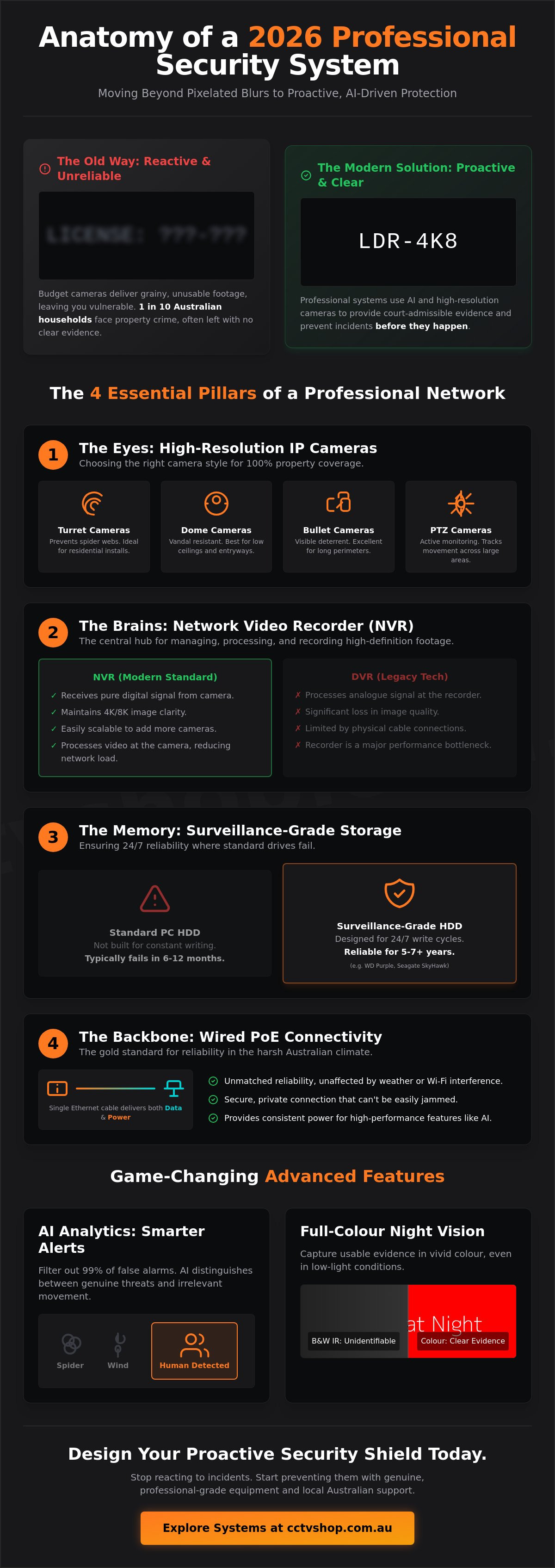
A professional security setup relies on four essential pillars: cameras, the recorder, storage, and connectivity. IP (Internet Protocol) technology serves as the foundation for modern 2026 systems, allowing for high-resolution data transmission that far exceeds old analogue capabilities. Choosing high-grade hardware ensures your security cameras systems remain functional for 5 to 7 years, rather than failing after the first Australian summer heatwave. The synergy between these components determines whether you capture a grainy blur or a court-admissible face ID.
Choosing the Right Camera Styles
Selecting the right form factor depends on your specific environment. Turret cameras are the preferred choice for Australian residential installs because their ball-and-socket design prevents spiders from nesting over the lens, a common issue with older styles. Dome cameras offer high vandal resistance for low-ceiling areas like entryways, while Bullet cameras act as a visible deterrent for long perimeters. For active monitoring of large open spaces, PTZ (Pan-Tilt-Zoom) cameras provide the ability to track movement across wide areas. Use wide-angle 2.8mm lenses for front yards and narrow 4mm or 6mm lenses to capture crisp detail at narrow entry points.
The Brains: NVR vs. DVR Recorders
NVRs (Network Video Recorders) are the superior choice for high-definition IP camera systems. Unlike older DVRs that process data at the recorder, NVRs receive a digital signal already encoded by the camera. This results in much higher image clarity and easier system scaling. When selecting a unit, pay attention to the 'Channel' count. This number dictates how many cameras your system can actually support; an 8-channel NVR is capped at eight cameras, even if you have extra ports on a separate switch. To explore high-performance hardware, learn more about Hikvision NVR options and their specific throughput capabilities.
Surveillance-Grade Storage: WD Purple and Seagate SkyHawk
Standard PC hard drives aren't built for the 24/7 write-cycles of a security system. They typically fail within 6 to 12 months when subjected to constant recording. Surveillance-grade drives like WD Purple or Seagate SkyHawk are engineered specifically for 90% write and 10% read operations. Calculating your needs is vital for long-term utility. To store 30 days of continuous 4K footage from four security cameras systems at 20fps, you'll generally require 8TB to 10TB of storage when using H.265+ compression technology.
Professional installations almost exclusively use Power over Ethernet (PoE) to simplify the network. This allows a single Cat6 cable to provide both high-speed data and electrical power. Adhering to established Power over Ethernet (PoE) standards ensures your cameras receive stable voltage without needing local power points at every mounting location. If you're designing a complex layout, it's a good idea to get expert advice from our local technical support team to ensure your power budget matches your hardware requirements.
Wired PoE vs. Wireless: Reliability in the Australian Climate
Choosing the right architecture for security cameras systems involves more than just picking a brand. The fundamental debate between wired Power over Ethernet (PoE) and wireless battery-powered units often centers on installation speed versus long-term performance. While wireless cameras offer a "plug-and-play" appeal, professional security standards consistently favor wired PoE for permanent installations. This preference is rooted in the technical stability required for 24/7 monitoring and high-resolution recording.
The perceived ease of installing battery cameras is frequently a myth when you consider the full lifecycle of the product. Users often find themselves climbing ladders every three to six months to recharge units, which becomes a significant burden for multi-camera setups. In contrast, a PoE system requires a single cable run that provides both high-speed data and stable power. This configuration eliminates the risk of "dead zones" caused by thick brick walls or signal interference from common household appliances that often plague wireless networks.
PoE (Power over Ethernet) Advantages
- Single-cable installation: A single Cat5e or Cat6 cable handles both power and data transmission, reducing the complexity of the wiring process.
- Signal Integrity: PoE systems are immune to Wi-Fi jammers and signal de-authentication attacks. The CCTV Technology Handbook emphasizes that a physical connection is the most reliable method for ensuring continuous video capture.
- Bandwidth Performance: These systems provide consistent high-bandwidth for 4K and 8K video streams without the lag or frame-dropping common in saturated wireless environments.
The Australian climate presents unique challenges for hardware longevity. In many parts of the country, summer temperatures frequently exceed 40°C. These extreme heat levels significantly impact lithium-ion battery health, often reducing total capacity by 15% to 20% after just one year of exposure. High UV levels, which are notably more intense in Australia than in many other regions, can also degrade the plastic housings of cheaper wireless units and affect signal penetration through external building materials over time.
When to Consider Wireless or Solar Systems
Wireless systems remain a viable choice for specific, specialized applications. Reolink wireless systems are excellent for temporary monitoring or rental properties where permanent cabling isn't an option. For remote farm gates or rural perimeters where mains power is inaccessible, solar-powered surveillance provides a pragmatic solution. These setups can be paired with wireless bridges to transmit data across distances of up to 5 kilometres, allowing for comprehensive coverage of large properties without the cost of extensive trenching.
For property owners who need specialized equipment like trail cameras for rural monitoring or outdoor activities, Vse za Lov in Prosti Čas provides a wide selection of professional-grade gear.
While wired systems require a higher initial effort for cable routing, they demand virtually zero physical maintenance compared to the frequent battery swaps and signal troubleshooting inherent in wireless setups.
Advanced Features: AI, Analytics, and Night Vision
Modern security cameras systems have moved past passive recording. They're now intelligent tools that understand their environment. By using deep-learning algorithms, technologies like Hikvision’s AcuSense and Dahua’s WizSense filter out up to 90% of false alarms. This means your system ignores falling leaves, heavy rain, or stray pets, focusing instead on real threats. This level of precision ensures that when your phone alerts you at 2:00 AM, it's for a reason that actually requires your attention.
Human and Vehicle Detection
Traditional motion detection triggers whenever pixels change, which leads to "notification fatigue" from constant false alerts. AI-driven systems are different. They're trained to recognise the specific skeletal shapes of humans and the distinct outlines of vehicles. You'll only receive a push notification when a genuine person or car enters your perimeter. For those looking to dive deeper into these capabilities, you can explore Dahua WizSense AI features to see how this tech secures Australian properties. Configuring these alerts takes minutes but saves hours of frustration by providing relevant, actionable data.
Night Vision Breakthroughs: ColorVu and Full-colour
Identifying a suspect's clothing or the exact colour of a getaway car is critical for police investigations. Traditional infrared (IR) night vision produces grainy, black-and-white images that often wash out facial features. Modern ColorVu and Full-colour cameras use F1.0 large apertures and warm supplemental lighting to maintain vivid colour in near-total darkness. While IR is still useful for covert surveillance in specific scenarios, 24/7 colour technology provides the superior evidence needed for successful prosecutions. Seeing the world in colour at midnight isn't just a luxury; it's a fundamental shift in how we approach nocturnal security. Beyond security, to understand how professional-grade imaging is used for high-impact communication, check out Digital Content Studios and their latest guide to cinematic excellence.
Proactive Deterrence and Rapid Retrieval
Finding evidence shouldn't take all day. Smart Search technology allows you to filter through terabytes of data in seconds. You can specify a search for a "person" or a "vehicle," and the system will highlight every instance that match occurs. This is a massive leap forward from older security cameras systems where you'd spend hours manually scrubbing through timelines.
Many 2026 models also feature two-way audio and active deterrence. If the AI detects a human in a restricted zone after hours, it can automatically trigger a loud siren and flashing red-and-blue strobes. This warns the intruder they're being watched and often prevents a break-in before any damage occurs. You can even use your smartphone to speak through the camera, giving you total control from anywhere in Australia.
Ready to upgrade to an AI-powered system? Contact our local experts for a tailored security recommendation.
Planning and Designing Your DIY Security System
Designing a layout for your security cameras systems requires more than just mounting hardware where it looks convenient. A professional-grade installation starts with a bird's-eye view of your property to identify critical vulnerabilities. You'll need to account for the Australian Privacy Act 1988, which generally permits filming your own property but prohibits capturing areas where neighbours have a reasonable expectation of privacy, such as bedrooms or swimming pools. Aim your lenses away from these zones to avoid legal disputes and maintain community harmony.
Technical performance depends heavily on your local network. A four-camera 4K system can generate upwards of 40 Mbps of continuous internal traffic. If you rely on a standard ISP-provided router, this load can cause bottlenecking, leading to dropped frames or lag. Using a dedicated Network Video Recorder (NVR) with a built-in PoE switch isolates this traffic from your home Wi-Fi. This ensures your streaming services don't compete with your security recordings. Specialist hardware from brands like Hikvision or Dahua offers superior builds compared to "big box" retail kits, which often use inferior sensors that fail in low-light conditions.
Mapping Coverage and Avoiding Blind Spots
Focus your efforts on choke points. These are the specific areas an intruder must pass through, such as side gates, driveways, and front entries. Follow the 3-metre rule: mount your cameras at a height of approximately 3 metres. This height is high enough to prevent easy tampering while maintaining a shallow enough angle to capture clear facial features rather than just the tops of heads. For more detailed advice on selecting the right hardware for these locations, see our guide to choosing home security cameras.
Technical Support and the CCTV Shop Advantage
Purchasing from a local specialist ensures you aren't left stranded during a complex configuration. While international marketplaces might offer lower entry prices, they often lack RCM (Regulatory Compliance Mark) approval and local warranties. CCTV Shop provides genuine Australian stock, meaning your 3-year warranty is handled right here in Australia. Our local technical support team understands the specific nuances of Australian networking environments and can guide you through remote access setups or firmware updates. Implementing high-quality security cameras systems requires precision, and having an expert a phone call away is invaluable.
Before you start your weekend project, ensure your cart includes these essentials for a successful install:
- High-Endurance Storage: A Western Digital Purple or Seagate SkyHawk drive, as standard PC drives will fail under 24/7 write cycles.
- Quality Cabling: Solid copper Cat6 cable rather than Copper Clad Aluminium (CCA) for better power delivery and signal integrity.
- Weatherproofing: Junction boxes for every external camera to protect RJ45 connections from moisture and corrosion.
- Power Protection: A basic UPS (Uninterruptible Power Supply) to keep the system running during a power surge or blackout.
Secure Your Property with 2026 Surveillance Technology
Navigating the 2026 landscape of security cameras systems requires a focus on technical reliability and smart integration. You've learned that choosing between wired PoE and wireless setups depends heavily on your specific site requirements and the harsh Australian climate. Prioritizing AI-driven analytics ensures your system doesn't just record events but actively identifies threats in real-time. Whether you're securing a residential driveway or a commercial perimeter, the right hardware provides a permanent sense of control.
As an Australian-owned and operated specialist, CCTV Shop bridges the gap between professional-grade hardware and accessible DIY installation. We provide free DIY installation guides for every purchase, ensuring your setup meets industry standards from day one. If you run into technical hurdles, our expert local technical support team is available to provide direct assistance. You don't have to settle for off-the-shelf compromises when tailored protection is within reach.
Build your custom security system with professional-grade hardware at CCTV Shop
Take the first step toward a safer environment today; we're here to help you get it right.
Frequently Asked Questions
Is a wired security camera system better than a wireless one?
Wired security camera systems are superior for long-term reliability because they don't rely on fluctuating Wi-Fi signals. A Power over Ethernet (PoE) setup provides both power and data through a single Cat6 cable, ensuring 99.9% uptime compared to wireless alternatives. While wireless cameras offer easier installation, they often suffer from signal interference in Australian homes built with brick or concrete.
Do I need a subscription for my security cameras systems?
You don't need a subscription if you choose a professional system with a local Network Video Recorder (NVR). Modern security cameras systems from brands like Hikvision and Dahua allow you to store footage directly on an internal hard drive, which removes ongoing monthly fees. This approach saves you between A$120 and A$200 per year compared to cloud-only consumer brands that charge for 30 day video history.
Can I install a professional NVR system myself?
You can install a professional NVR system yourself if you have basic networking knowledge and tools. Most modern PoE systems use "Plug and Play" technology that automatically configures the camera once it's connected to the NVR. However, under Australian state regulations like the NSW Security Industry Act 1997, a licensed security technician is required for installations in commercial premises or for systems providing formal security services.
How much storage do I need for 4K security cameras?
A 4-camera 4K system recording at 20 frames per second requires approximately 6TB of storage for 14 days of continuous footage using H.265+ compression. This compression standard is 50% more efficient than the older H.264 codec. If you switch to motion-triggered recording, that same 6TB drive can often store up to 60 days of high-definition events.
What is the best security camera for night vision?
The best security camera for night vision is one equipped with full-color technology, such as Hikvision ColorVu or Dahua Full-color. These sensors feature an F1.0 large aperture that captures 4 times more light than standard cameras. These systems provide 24/7 color imagery even in environments with 0.0005 lux, which is roughly equivalent to a moonless night.
Will my security system work if the internet goes down?
Your security system will continue to record and store footage locally even if your internet connection fails. The NVR and cameras communicate through a local area network (LAN), so they don't need an external web connection to function. You'll only lose the ability to view live feeds or receive mobile alerts on your smartphone until the internet service is restored.
How many cameras can I add to a single NVR system?
The number of cameras you can add is determined by the specific channel count of your NVR, typically available in 4, 8, 16, or 32-channel configurations. You can't exceed the hardware limit of the recorder. For example, an 8-channel NVR supports exactly 8 cameras. It's best to choose a recorder with 2 or 4 spare channels to allow for future expansion without replacing the entire unit.
What is the difference between Hikvision and Dahua systems?
Hikvision and Dahua are the two largest global manufacturers, collectively holding over 40% of the global market share. Hikvision is often praised for its robust VMS software and wide range of specialty lenses, while Dahua is frequently selected for its intuitive user interface and competitive performance in low-light conditions. Both brands provide 3-year warranties on their Australian-certified security cameras systems, making them equally reliable choices for local homeowners.