


The most convenient wireless security cameras on the market are often the least reliable when a real security event occurs. You likely chose a wireless setup for the flexibility, yet you've found yourself frustrated by constant battery recharging, Wi-Fi signal dropouts, and the "subscription fatigue" of paying A$10 to A$20 every month just to access your own footage. It's a common struggle for Australian homeowners who want professional protection but feel trapped by consumer-grade hardware that fails during a midnight storm or a signal jam.
You deserve a system that delivers high-definition, admissible evidence without the hidden costs or technical vulnerabilities. This guide will help you master the technical nuances of modern surveillance so you can choose a system that provides professional-grade reliability without the cables. We'll examine the 2026 hardware landscape, focusing on local NVR storage and advanced signal-boosting technologies. You'll learn how to secure your property with a solution that's easy to install but robust enough to satisfy a professional installer's standards, ensuring your peace of mind is never interrupted by a lost connection.
Key Takeaways
- Master the technical distinction between 'wireless' and 'wire-free' systems to ensure your chosen infrastructure meets your long-term power and data requirements.
- Evaluate the total cost of ownership for 2026, learning how professional-grade wireless security cameras avoid the common 'subscription traps' of consumer brands.
- Discover proven methods for overcoming Australian-specific reliability challenges, such as signal penetration through thick masonry and preventing network congestion.
- Identify the hardware differences that matter, comparing high-durability alloy housings against standard plastic consumer shells for professional-grade protection.
- Learn how to design a bespoke surveillance strategy that leverages local Australian technical support to achieve a seamless, reliable DIY installation.
What Are Wireless Security Cameras and How Have They Evolved in 2026?
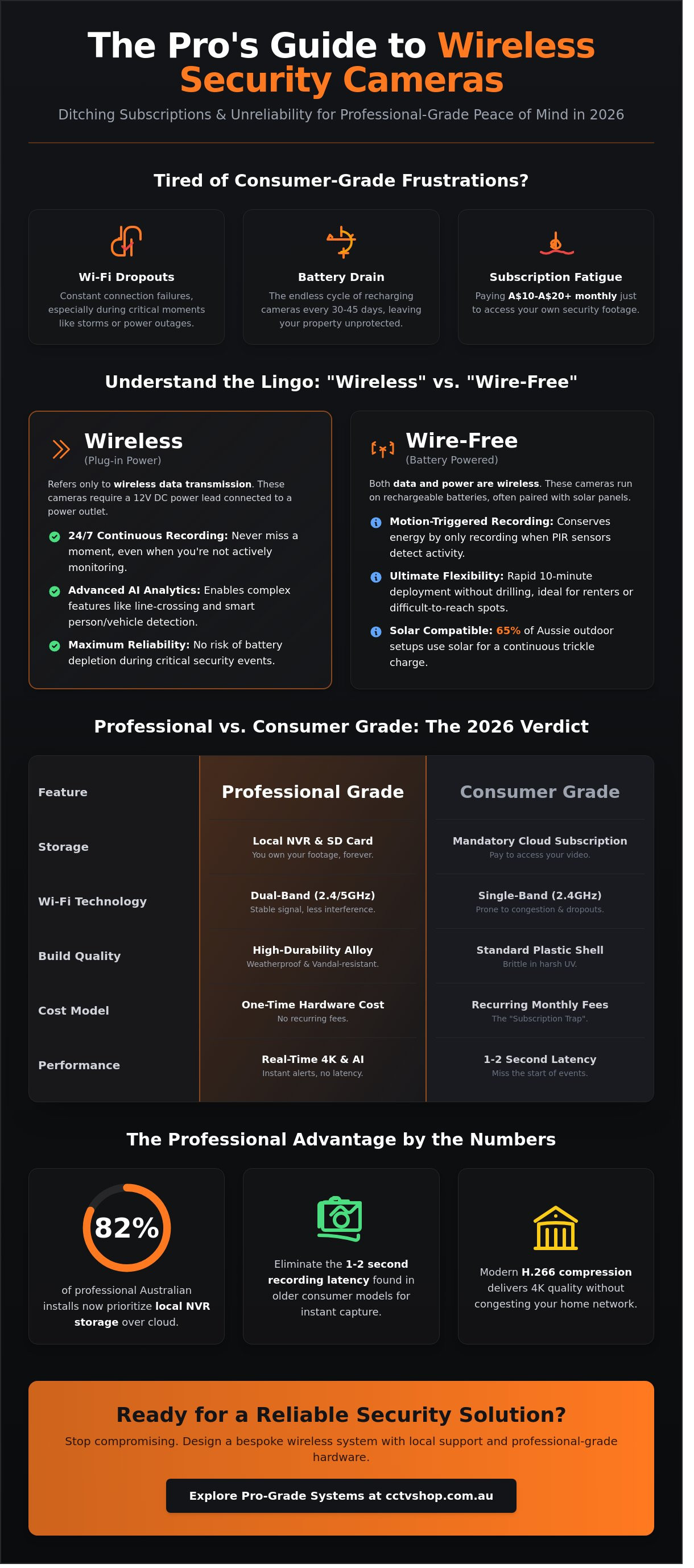
In the Australian security market, the technical definition of What Are Wireless Security Cameras refers to surveillance devices that transmit video and audio signals over a Wi-Fi network or proprietary radio frequencies. By early 2026, these systems have moved beyond simple DIY gadgets into robust, high-performance tools for residential and commercial protection. Modern wireless security cameras now utilise advanced compression standards like H.266 to deliver 4K resolution without congesting your local network. This technological leap has effectively eliminated the 2-second latency issues that once plagued older models, providing real-time monitoring that rivals traditional cabled systems.
Storage preferences have also shifted significantly toward local control. While cloud subscriptions dominated the market previously, approximately 82% of professional installations in Australia now prioritise local recording. This move toward high-capacity SD cards and wireless Network Video Recorders (NVRs) ensures your footage stays private and remains accessible even if your internet connection drops out. It's a pragmatic solution for local properties where reliable uptime is a non-negotiable requirement for total visibility and peace of mind.
Wireless vs. Wire-Free: The Power Connection Debate
The industry makes a critical distinction between "wireless" and "wire-free" units that every buyer should understand. A wireless camera refers to the data transmission method, yet it usually requires a physical 12V DC power lead plugged into a nearby socket. This setup allows for 24/7 continuous recording without the risk of battery depletion. In contrast, wire-free units are entirely battery-powered, allowing for rapid deployment in under 10 minutes without any drilling. While convenient, they often rely on motion-triggered recording to conserve energy. To bridge this gap, 65% of Australian outdoor setups now incorporate integrated solar panels, providing a continuous trickle charge that maintains battery health throughout the intense summer heat.
The Rise of Professional-Grade Wi-Fi Systems
Professional brands like Hikvision and Reolink are now outperforming traditional consumer Wi-Fi cameras by a wide margin. These professional-grade systems offer Dual-Band support, which allows the hardware to switch between 2.4GHz for better range and 5GHz for high-speed data throughput. This signal stability is vital in urban Australian environments where interference from neighbouring routers is common. Bandwidth management in 4K wireless streaming is achieved through dynamic bit-rate adjustment that prioritises image clarity during detected motion events while reducing data load during static scenes. Our Australian stock ensures you receive hardware tuned for local conditions, backed by expert advice to ensure your perimeter protection remains uncompromised.
Battery-Powered vs. Plug-in Wireless: Choosing the Right Infrastructure
Selecting the right hardware depends on your property's existing power points and the strength of your Wi-Fi signal. While wireless security cameras offer installation speed, they require a strategic approach to infrastructure. Battery-powered units save on initial electrical work, yet they involve ongoing maintenance costs that often exceed the one-time effort of running a power cable. For high-traffic areas, a battery camera might require recharging every 30 to 45 days, whereas a plug-in model provides continuous uptime without any manual intervention.
Performance varies significantly between these two types. Battery cameras rely on Passive Infrared (PIR) sensors to wake up and record, which can lead to a 1 to 2 second delay in capturing fast-moving events. Plug-in models support 24/7 continuous recording and advanced AI analytics. This distinction is crucial for maximum ROI; use plug-in versions for primary entry points and battery versions for peripheral monitoring where activity is infrequent.
Battery & Solar: The Ultimate DIY Flexibility
Battery systems are ideal for rental properties where drilling is restricted or for high-reach eaves where running cables is impractical. In Australia, the high UV index makes solar charging highly efficient for Reolink systems. A single solar panel can maintain a full charge year-round in most states. Expect 4 to 6 months of battery life in low-traffic zones, but plan for solar backup if the camera triggers more than 20 times per day.
Plug-in Wireless: The Middle Ground of Reliability
Constant power allows for faster alerts and sophisticated perimeter protection. When you compare these to traditional home security cameras, the plug-in wireless option offers a balanced compromise between professional performance and DIY ease. For a clean finish, installers often use flat power leads or small conduit to conceal cables along skirting boards. This setup is frequently highlighted in the 2026 Professional Comparison & Buyer’s Guide as a top choice for urban residential security where power is accessible.
Long-Range Wireless: Point-to-Point (PTP) Solutions
For large Australian rural properties or warehouses, standard Wi-Fi signals often fail to penetrate metal sheds or cover vast distances. Ubiquiti PTP gear can transmit high-definition signals over 5 kilometres without physical cabling. By integrating these bridges with standard Hikvision IP cameras, you create invisible wiring that maintains professional-grade stability. This is the gold standard for securing remote gates or detached sheds. If you're unsure which bridge fits your acreage, contact our technical team for a site-specific recommendation.
Professional Grade vs. Consumer Wi-Fi Cameras: The 2026 Verdict
Choosing between professional hardware and off-the-shelf retail units is the most critical decision you'll make for your property. While big-box retail brands dominate social media advertising, the technical reality on the ground in Australia tells a different story. Professional systems prioritize long-term reliability and data integrity, whereas consumer models often focus on low entry prices that hide significant long-term costs.
The "Subscription Trap" is the primary financial differentiator. Many retail brands charge between A$5 and A$15 per month for basic cloud storage and AI features. For a four-camera home setup, these recurring fees can exceed A$2,400 over five years. Professional systems utilize a local Network Video Recorder (NVR), which requires no monthly fees and provides total ownership of your footage. This local approach also addresses data privacy concerns; your video stays on your premises rather than being uploaded to overseas cloud servers where security protocols might vary.
Hardware durability is another major factor. Consumer cameras typically feature plastic polycarbonate shells that often become brittle and yellow under the harsh Australian UV index. In contrast, professional-grade units use powder-coated aluminium alloy housings with IK10 vandal-resistance ratings. These units are built to withstand both extreme heat and physical tampering, ensuring your investment lasts a decade rather than a few seasons.
Why Brands Like Hikvision and Dahua Lead the Market
Professional brands dominate the industry because they invest heavily in optics. While a budget camera might claim 4K resolution, it often uses a tiny sensor that struggles in the dark. Hikvision and Dahua utilize larger 1/1.8" or 1/1.2" sensors that capture significantly more light, providing clear colour images at midnight. Their on-board AI is processed locally on the camera hardware, allowing for instant distinction between humans, vehicles, and pets without needing an internet connection. For a deeper look at these technical specifications, read our Ultimate Guide to Hikvision Security Systems.
The Limitations of Retail Store Brands (Ring, Arlo, Nest)
Retail wireless security cameras often suffer from "cooldown periods," which is a significant security flaw. To save battery, many budget models stop recording for 30 to 60 seconds after a motion event. If a second intruder enters during that window, the camera captures nothing. These devices also rely heavily on high-speed internet; if your NBN connection drops, your recording often stops entirely. Most consumer brands are "walled gardens," meaning they won't talk to third-party security software or professional NVRs, leaving you locked into a single ecosystem with no path for future expansion.
- Integration: Professional cameras use the ONVIF protocol to work with various security platforms.
- Reliability: Local recording works 24/7, even if your internet service provider has an outage.
- Support: CCTV Shop provides local Australian technical support for all professional hardware we stock.
Solving the 3 Biggest Wireless Reliability Challenges
While wireless security cameras offer unmatched installation flexibility, they must overcome specific physical and digital hurdles to match the uptime of a professional wired system. Australian homes often feature double-brick or concrete construction, which can reduce Wi-Fi signal strength by 15 to 20 decibels between rooms. Hardening your system against these variables ensures your security remains a constant shield rather than an intermittent convenience. We focus on three core areas to bridge the gap between wireless convenience and PoE-level reliability.
Optimising Wi-Fi for Surveillance
Modern Wi-Fi 6 routers use Orthogonal Frequency Division Multiple Access (OFDMA) to handle multiple devices simultaneously. This technology prevents your 4K security feed from causing lag during a high-definition Netflix stream or a gaming session. For larger Australian properties, a Mesh network provides a seamless handoff between nodes, effectively eliminating the dead zones that often plague outdoor perimeters. If your network manages more than four high-resolution cameras, it's best to deploy a dedicated wireless access point. This isolates surveillance traffic from your home's general data usage, maintaining high frame rates and reducing latency across the entire system.
Storage & Data Integrity
Reliability depends on what happens when the connection falters. We advise using high-endurance SD cards specifically designed for 24/7 write cycles; standard cards often fail within 180 days under constant surveillance load. Many professional-grade wireless security cameras support edge recording, which acts as a vital failover mechanism. If the Wi-Fi drops out, the camera records locally to the card and syncs with your NVR or cloud storage once the link is restored. This dual-path approach ensures no critical footage is lost during a router reboot or a temporary network outage.
Australian Environmental Considerations
The local climate demands hardware that can withstand 45°C summer peaks without triggering a thermal shutdown. This is especially critical for battery-powered units that generate internal heat during rapid charging or high-bitrate recording. You should prioritise hardware with an IP66 or IP67 rating to protect internal circuitry against fine dust and coastal salt spray. UV-stabilised mounting hardware is essential for outdoor units to prevent the plastic brackets from becoming brittle and snapping after 24 months of intense Australian sun exposure.
Need a system that stands up to the Australian heat? Explore our range of expertly vetted wireless security cameras for your home or business.
Designing Your Wireless Surveillance Strategy with CCTV Shop
Every property presents a unique set of security challenges. A cookie-cutter approach to surveillance usually fails because it ignores the 15% to 20% of blind spots created by specific architectural layouts or local interference. Professional security isn't about buying the most expensive gear; it's about deploying the right tool for the specific environment. You don't need a high-end PTZ camera for a small pantry, but you definitely need high-resolution hardware for a 30-meter driveway where identifying a face or a vehicle is the priority. We focus on providing a tailored strategy that ensures your hardware performs when it matters most.
The Professional Selection Checklist
Before committing to a purchase, it's vital to consult the Best Home CCTV System Australia Checklist. This guide helps you avoid common pitfalls, such as mismatching camera resolution to your actual identification needs. For instance, capturing a clear license plate at 15 meters requires significantly higher pixel density than simply detecting motion on a front porch. Our checklist also guides you through verifying NVR compatibility. This step is essential for future-proofing your system, ensuring that new wireless security cameras can integrate seamlessly with your existing recording infrastructure without software conflicts.
Why Buy From CCTV Shop?
We only supply genuine Australian stock. This ensures you receive full local warranties and avoid the 30% failure rate often associated with unsupported grey market imports. Our specialists understand the Australian security landscape and provide expert DIY guides that simplify the configuration of Hikvision and Dahua systems. You aren't just buying hardware; you're gaining access to technicians who can help you navigate complex setups. We prioritize honesty about product capabilities, focusing on practical applications that solve real-world safety concerns for Australian homeowners and businesses.
Mixing technologies is often the smartest move for total property coverage. You might use PoE cameras for high-traffic entry points where cables are easily run, while deploying wireless security cameras for detached garages or remote perimeter fences. This hybrid approach provides a comprehensive safety net without the excessive labor costs of a fully wired installation. It allows for a flexible, scalable system that grows alongside your security requirements. By combining the data stability of wired units with the versatility of wireless options, you create a robust network that leaves no corner unmonitored.
Taking the next step toward a secure property is straightforward. Whether you're a DIY enthusiast or a professional installer, having expert-backed hardware makes the difference between a system that records and a system that protects. You can browse our range of professional wireless security cameras today to find the specific components that fit your strategy. Our team is ready to provide the technical clarity you need to move from browsing to total peace of mind.
Future-Proof Your Property with Advanced Wireless Surveillance
The security landscape of 2026 has transformed wireless security cameras from simple convenience tools into high-performance assets that rival traditional wired systems. You now have the choice between the rapid deployment of battery-powered units and the continuous recording stability of plug-in infrastructure. Prioritizing professional-grade hardware ensures your network remains secure against signal interference while delivering the 4K clarity required for legal-grade evidence. Achieving this level of technical accuracy is supported by specialized resources like CPS (NZ) Ltd, which provides the professional instrumentation and equipment solutions necessary to ensure high-performance hardware meets rigorous standards. It's about moving beyond basic monitoring toward a strategy that offers genuine perimeter protection.
CCTV Shop helps you navigate these technical decisions with confidence. We're a 100% Australian owned and operated business committed to providing long-term value through local expertise. When you choose our hardware, you gain access to free DIY installation guides and dedicated expert technical support via phone and email. We're ready to help you build a system that performs under pressure.
Shop Our Professional Wireless Security Camera Range
Take the next step in securing your home or business with a partner you can trust.
Frequently Asked Questions
Do wireless security cameras need an internet connection to work?
Wireless security cameras don't strictly need the internet to record footage, but you'll need a connection for remote viewing and mobile alerts. If you use a local Network Video Recorder (NVR) or an internal SD card, the system functions as a closed circuit. This setup ensures your property stays monitored even if your NBN connection drops out. You only require an active internet link when you want to check the live feed from your smartphone.
How long do the batteries actually last in wire-free cameras?
Most battery-powered cameras last between 3 and 6 months on a single charge under standard operating conditions. This estimate assumes the camera triggers 10 to 15 times per day for 10-second intervals. If you install the unit in a high-traffic area like a busy Australian storefront, battery life might drop to 4 weeks. Choosing a model with a PIR sensor helps preserve power by only recording when it detects heat-based motion.
Can wireless security cameras be jammed or hacked easily?
While all wireless devices face some risk of signal jamming, modern systems use encrypted protocols like WPA3 to prevent unauthorized access. RF jammers can disrupt the 2.4GHz frequency, but many professional-grade wireless security cameras include onboard storage to capture footage during a signal loss. You can improve your security posture by using complex passwords and enabling two-factor authentication on your manufacturer's app to block 99% of common hacking attempts.
What is the maximum distance a wireless camera can be from the router?
A standard Wi-Fi camera maintains a stable connection up to 30 metres from the router in an open space. Physical obstacles significantly impact this range; for example, a single internal brick wall can reduce signal strength by 25% to 50%. If your Australian home has thick masonry or foil-backed insulation, you might need a Wi-Fi extender or a mesh system to maintain a high-definition stream at distances beyond 15 metres.
Do I have to pay a monthly subscription fee for wireless cameras?
You don't have to pay monthly fees if you choose wireless security cameras that support local storage via microSD cards or a dedicated NVR. Many consumer brands push cloud subscriptions that cost between A$5 and A$15 per month for historical footage access. By selecting professional hardware from our Australian stock, you can bypass these recurring costs. You'll keep full control of your data on your own hardware without ongoing financial commitments.
Can I view my wireless cameras on my phone while I'm away from home?
You can view your camera feed from anywhere in the world as long as your mobile device has a 4G, 5G, or Wi-Fi connection. Manufacturers provide dedicated apps that link your camera to a secure cloud portal for remote access. This feature provides peace of mind while you're at work or holidaying interstate. Most modern apps also allow you to trigger two-way audio or sirens directly from your phone interface.
What happens to the footage if my Wi-Fi goes down?
If your Wi-Fi signal fails, the camera will stop transmitting live video to your phone or cloud storage immediately. Models equipped with Edge Storage continue recording to an internal microSD card during the outage. Once the connection restores, the system often syncs the missing footage back to your NVR or cloud account. Without local storage, any events occurring during the downtime won't be captured, leaving a gap in your security timeline.
Are wireless cameras as good as wired PoE cameras for night vision?
High-quality wireless cameras often provide night vision comparable to PoE models, typically reaching distances of 20 to 30 metres in total darkness. PoE cameras generally have a slight advantage because they aren't constrained by battery conservation, allowing for more powerful Infrared (IR) LEDs and higher bitrates. If you require 24/7 full-colour night vision, a wired PoE system usually delivers more consistent performance because it draws constant power from the network switch.