


Is your surveillance system actually securing your property, or is it just a glorified motion sensor that triggers every time a spider crawls across the lens? Many Australians discover that entry-level home security cameras often fail during critical moments, providing nothing but pixelated shadows and "connection lost" prompts. We agree that a security system should provide genuine peace of mind rather than a stream of false alarms and subscription invoices. You deserve hardware that performs reliably under the harsh Australian sun and maintains a stable connection across your entire property.
This 2026 professional buyer’s guide promises to help you master the technical nuances of professional surveillance to build a high-performance system. You'll learn how to navigate specifications like focal lengths, NVR storage, and AI-driven perimeter protection to ensure your footage is usable when it matters most. We will examine the specific hardware configurations that eliminate Wi-Fi dropouts and provide crystal-clear identification at distances exceeding 10 metres, giving you total visibility and control over your home security.
Key Takeaways
- Understand the critical shift from passive recording to active AI-driven prevention and why professional-grade sensors outperform standard consumer alternatives.
- Learn how to decode hardware specifications to prioritize low-light performance and true image clarity over simple megapixel counts.
- Compare the stability of Power over Ethernet (PoE) against wireless systems to ensure your surveillance remains resilient against signal interference in the Australian environment.
- Determine your specific NVR storage requirements to effectively manage high-definition 4K data for a full 30-day retention cycle.
- Master the "Blind Spot" audit to strategically position your home security cameras for maximum legal coverage and a comprehensive, layered defense.
What Defines a Professional Home Security Camera in 2026?
The security industry has undergone a fundamental shift. In 2026, professional home security cameras are no longer just digital witnesses to a crime; they're active prevention tools. While older systems focused on capturing footage for later review, modern hardware uses edge-processing to stop incidents before they escalate. This evolution relies on the 4K (8MP) standard, which provides 3840 x 2160 pixels of clarity. This resolution is now the baseline for residential installs because it allows for digital zooming without losing the forensic detail required by Australian law enforcement.
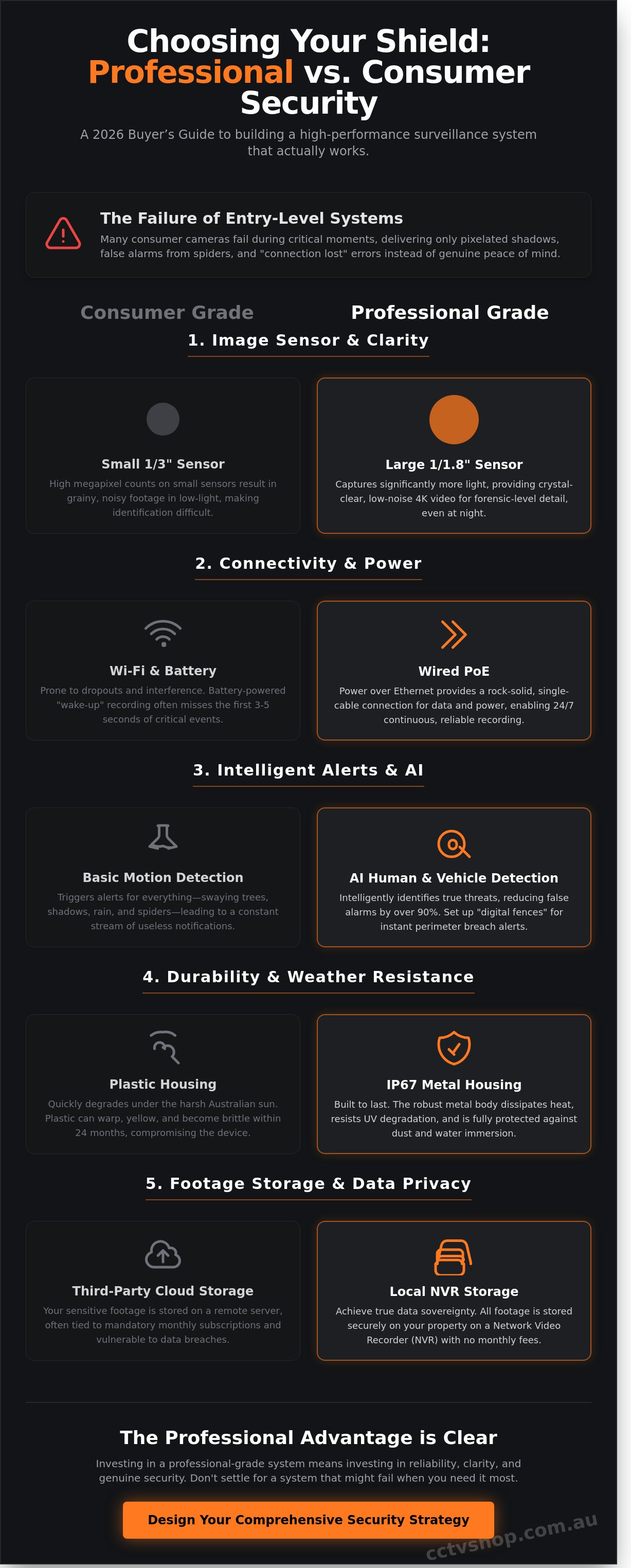
Professional IP cameras distinguish themselves through physical hardware. While consumer brands often use small 1/3-inch sensors, professional-grade units employ larger 1/1.8-inch or 1/1.2-inch sensors. These larger surfaces capture more light, reducing graininess in low-light conditions common in suburban Australian streets. Dedicated onboard processors handle high frame rates, typically 25 to 30 frames per second, ensuring that fast-moving objects don't appear as motion-blurred streaks. This hardware-centric approach is the foundation of modern Closed-circuit television (CCTV) systems.
Consumer vs. Professional Grade: The Real Difference
The Australian sun is brutal on equipment. Professional cameras use IP67-rated metal housings to dissipate heat and resist UV degradation, whereas plastic consumer models often warp or yellow within 24 months. Reliability also stems from power delivery. Professional systems use Power over Ethernet (PoE) for 24/7 continuous recording. Battery-powered "wake-up" sensors often miss the first three seconds of an event, which is usually when the most critical action occurs. Local Network Video Recorders (NVRs) ensure data sovereignty, keeping your footage on your property rather than on a vulnerable third-party cloud server.
The Evolution of AI in Home Surveillance
AI has solved the "crying wolf" problem of motion alerts. Modern algorithms distinguish between the swaying of a gum tree and a person approaching a side gate. By filtering for humans and vehicles, these systems reduce false alarms by over 90 percent compared to basic pixel-motion detection. Perimeter protection and line-crossing technology allow users to draw virtual boundaries that trigger immediate sirens or floodlights if breached. AI-driven perimeter protection for modern NVRs acts as a digital fence that intelligently identifies and alerts homeowners to specific unauthorized intrusions while ignoring benign environmental movement.
Choosing professional home security cameras means investing in longevity. A system built on dedicated hardware and high-quality optics provides a level of clarity that consumer gadgets cannot match. Just as precision lenses are vital for surveillance, they are equally important for your personal sight; to learn more about premium local eyewear, visit Australian Made Vision. At CCTV Shop, we prioritize these technical benchmarks to ensure your system remains functional and relevant for years to come.
Key Hardware Features: Resolution, Sensors, and Night Vision
High megapixel counts often dominate marketing brochures, but resolution is only one part of the clarity equation. While 8MP (4K) sensors provide incredible detail, the physical size of the sensor determines how much light the camera actually captures. A small sensor with high megapixels often results in "digital noise" during low-light conditions. For most Australian properties, a 4MP or 6MP camera with a larger sensor often outperforms a cheap 4K alternative by providing better contrast and sharper movement definition. High-performance home security cameras rely on this balance to ensure you can identify a face or a number plate rather than just seeing a blurry shape.
Australia’s harsh climate presents unique challenges for optical hardware. The intense midday sun creates high-contrast environments with deep shadows and bright highlights. To combat this, look for cameras with True Wide Dynamic Range (WDR) rated at 120dB or higher. This technology takes multiple exposures of the same frame and blends them; it ensures that a person standing in a sun-drenched doorway isn't reduced to a dark silhouette. Selecting the right lens focal length is equally critical. A 2.8mm lens provides a wide 100 to 110-degree view, which is ideal for front yards or large patios. For narrow side passages or long driveways, a 4mm or 6mm lens narrows the field of view but brings distant objects into much sharper focus.
Seeing in the Dark: IR vs. Full-Colour Night Vision
Traditional Infrared (IR) night vision uses LEDs to flood an area with light invisible to the human eye. While effective, it renders the world in black and white, making it impossible to identify the colour of a getaway car or a thief’s hoodie. The breakthrough of Hikvision ColorVu technology has changed this by using ultra-large apertures and advanced sensors to maintain vivid colour imaging in near-total darkness. If you prefer a stealthy approach, IR remains the standard; however, if capturing descriptive forensic evidence is your priority, supplemental white light sensors are the superior choice for modern home security cameras.
Smart Motion Detection and False Alarm Reduction
Old-fashioned motion detection triggered an alert every time a spider crawled across the lens or a tree swayed in the wind. Modern systems like Dahua WizSense use AI-powered deep learning to distinguish between humans, vehicles, and irrelevant background noise. This level of precision is mirrored in Hikvision’s AcuSense technology, which significantly improves mobile notification accuracy so you only check your phone when it truly matters. AI filtering saves storage space by only recording relevant events, ensuring your hard drive isn't filled with hours of empty footage. When positioning these smart sensors, remember to consult Australian privacy laws to ensure your surveillance remains within legal boundaries. If you need help matching these technical specs to your specific floor plan, our experts at CCTV Shop can provide a detailed hardware breakdown for your home.
PoE vs. Wireless: Which System Survives the Australian Environment?
Australian summers regularly exceed 40°C, creating a brutal environment for outdoor electronics. While wireless options offer quick installation, they often struggle with signal interference or "jamming" from external devices. Selecting the right home security cameras for your property requires understanding how different power and data delivery methods handle local conditions. Reliability is the core of any security strategy; a camera that fails during a heatwave or loses its Wi-Fi connection provides zero protection.
Environmental protection is equally vital. In coastal regions or areas with high humidity, exposed connections corrode within months. We recommend using dedicated junction boxes for every installation. These enclosures house the cable terminations, preventing water ingress and salt air from degrading the copper contacts. To ensure maximum durability for your wiring, you can explore Heat Shrink Crimp Joiners to create waterproof seals. This small addition extends the lifespan of your hardware by several years, ensuring your investment remains functional through every season.
The Case for Wired PoE Systems
Power over Ethernet (PoE) is the professional choice for high-performance home security cameras. A single Cat6 cable delivers both power and 4K data, which simplifies cable management and ensures a stable connection. While PCMag's top-tested cameras often highlight the convenience of consumer Wi-Fi models, professional Australian installations prioritize wired stability. Hardwired connections cannot be intercepted or blocked by cheap signal jammers, providing a higher tier of security. If you're scaling to a system with 4 or more cameras, a dedicated PoE switch is essential to manage the power load and data throughput without taxing your home router.
When to Choose Wireless or Solar Powered Cameras
Wireless and solar solutions serve a specific purpose for rural properties or remote gate monitoring where trenching cables isn't feasible. These units are excellent for off-grid applications, but they require consistent maintenance. Dust and bird droppings on solar panels can reduce charging efficiency by 30% or more, leading to battery depletion. For long-range links beyond the reach of standard Wi-Fi, we utilize Ubiquiti point-to-point gear to bridge distances of several kilometers. It's a robust way to bring remote cameras back to a central NVR without losing signal quality. Just remember that battery-operated cameras often throttle their recording time to save power, so they aren't ideal for high-traffic areas where constant surveillance is required.
NVRs and Storage: Managing Your Surveillance Data
While many people start their search for home security cameras by looking at lens quality, the way you store that footage is what determines the system's reliability. A Network Video Recorder (NVR) acts as the central brain of your security ecosystem. Unlike SD cards that live inside a camera and can be easily stolen or corrupted, an NVR provides a centralized, secure location for your data. It allows for 24/7 continuous recording, which is a significant upgrade over the "motion-only" clips found on most battery-powered devices.
Storage requirements have increased as 4K resolution becomes the Australian standard. To store 30 days of continuous 4K footage from a four-camera system, you generally need 8TB of storage. This calculation relies heavily on modern compression standards. H.265 and H.265+ codecs are essential technologies that reduce file sizes by up to 50% compared to the older H.264 format. This efficiency ensures you maintain high-definition clarity without exhausting your hard drive space in a matter of days.
The best part of a dedicated NVR system is the lack of ongoing costs. Once the hardware is installed, you can access your home security cameras via smartphone apps using P2P technology. This provides seamless remote viewing from anywhere in Australia without the burden of monthly cloud subscription fees. It's a professional solution that prioritizes long-term value and data ownership.
Surveillance-Rated Hard Drives vs. Standard Desktop Drives
You must never use a standard desktop PC drive in a surveillance system. NVRs require specialized drives like Western Digital Purple or Seagate SkyHawk. These are engineered for 24/7 write-heavy workloads, where the drive is recording 90% of the time. Standard drives are designed for 8-hour daily use and will likely fail within months due to heat stress and constant vibration. Using surveillance-rated hardware prevents data corruption and ensures your footage is there when you actually need it.
Data Privacy and Secure Remote Access
Security goes beyond physical cameras; it includes your digital network. We recommend using P2P (Peer-to-Peer) setups for remote access because they're significantly more secure than traditional port forwarding. Port forwarding leaves a permanent "open door" on your router that hackers can exploit. Additionally, keeping your NVR firmware updated is the most effective way to patch cybersecurity vulnerabilities. For a complete look at how to verify your system's integrity, refer to our Professional Selection Checklist.
Ready to secure your property with professional-grade hardware? Browse our range of NVRs and surveillance storage solutions today.
Designing Your Comprehensive Security Strategy with CCTV Shop
Building an effective defense for your property requires more than just mounting a single device. A professional strategy relies on layered security. By integrating high-quality home security cameras with video doorbells and perimeter sensors, you create a system where each component reinforces the others. This multi-tiered approach ensures that motion detected at a side gate triggers a recording before an intruder even reaches your front door, providing a proactive rather than reactive safety net.
Planning Your Camera Placement
The first step in any installation is a "Blind Spot" audit. You need to identify the most vulnerable entry points while maintaining compliance with Australian regulations. Research from various crime prevention units indicates that 70% of intruders attempt access through primary doors or ground-floor windows. Focus on these three priority zones:
- Primary Entry Points: Front and back doors where identification is most critical.
- Driveways and Garages: High-value areas that often require wide-angle lenses for vehicle tracking.
- Side Paths and Gates: Narrow corridors that benefit from "corridor mode" vertical viewing.
Legally, residential surveillance in Australia must respect the privacy boundaries set by local state laws and the Privacy Act 1988. You've got to ensure your field of view doesn't peer directly into a neighbour's windows or private backyard spaces. For the best results, mount cameras at a height of approximately 2.7 metres. This elevation protects the hardware from manual tampering while maintaining a steep enough angle to capture facial recognition details rather than just the tops of hats.
Why Source from a Specialist Wholesaler?
Choosing where to buy your home security cameras is as important as the hardware itself. CCTV Shop provides genuine Australian stock, which is a critical distinction in a market flooded with "grey market" imports. Buying local ensures your Hikvision or Dahua hardware includes official local firmware, allowing for seamless mobile app updates and superior cybersecurity protection against unauthorized access.
We support DIY installers by providing expert technical guidance that generic retail chains can't match. If you're struggling with NVR configuration or remote access setup, our Australian-based support team offers direct troubleshooting based on years of industry experience. We don't just sell hardware; we help you design custom bundles tailored to your specific floor plan. This ensures you have the exact number of ports and hard drive storage capacity needed for 24/7 peace of mind. Our focus is on providing a solution-first experience that delivers long-term value and technical reliability for every Australian homeowner.
Future-Proof Your Property with Professional Surveillance
Building a robust surveillance network in 2026 demands a shift from basic monitoring to high-definition perimeter protection. You've learned that prioritising 4K or 8K resolution sensors is essential for capturing identifiable details in varying light conditions. Moving toward PoE hardware ensures your system remains operational despite the intense Australian heat and UV exposure that typically compromises standard wireless units. Relying on local NVR storage instead of subscription-heavy cloud services guarantees you keep total control over your data with zero monthly fees.
CCTV Shop is here to simplify the technical transition. We're 100% Australian Owned & Operated, providing Genuine Local Stock with Full Warranty protection on every purchase. If you're planning a DIY installation, our specialists provide Expert Technical Support to get your system running perfectly. It's about more than just hardware; it's about achieving permanent peace of mind through reliable technology and professional-grade home security cameras.
Browse our range of Professional Home Security Cameras
Frequently Asked Questions
Do home security cameras require a monthly subscription fee?
You don't need a monthly subscription fee if you choose a professional NVR (Network Video Recorder) system with local storage. While many consumer-grade cloud brands charge between A$5 and A$15 per month for storage, local systems store footage on a physical hard drive at your premises. This provides a one-time investment that eliminates recurring costs and ensures your data remains under your control on Australian soil.
What is the best resolution for a home security camera in 2026?
4K (8-megapixel) resolution remains the gold standard, but 12-megapixel Ultra HD cameras are the premium choice for 2026. Higher pixel density allows for 3x digital zoom without losing critical detail like license plates or facial features. Most Australian homeowners now prefer 8MP sensors because they balance high-clarity evidence with efficient storage management on standard hard drives.
Can I install professional PoE security cameras myself?
You can install PoE (Power over Ethernet) home security cameras yourself, though Australian regulations often require a licensed cabler for permanent structural wiring. PoE systems are simpler than traditional setups because a single Cat6 cable provides both power and data. If you're comfortable with basic networking and mounting hardware, a plug-and-play NVR kit offers a straightforward path to professional-grade protection.
How long does a 4TB hard drive last with 4K security cameras?
A 4TB hard drive typically lasts between 7 and 10 days when recording four 4K cameras at 20 frames per second using H.265 compression. You can extend this to 30 days or more by enabling motion-triggered recording instead of 24/7 continuous capture. Modern AI-driven perimeter protection ensures the system only saves relevant events, which significantly optimizes your available storage space.
Do security cameras work when the internet goes down?
Your security cameras will continue to record and protect your property even if the internet goes down. Professional IP systems communicate directly with the NVR over a local area network, so footage is saved to the hard drive regardless of your ISP's status. You'll only lose remote viewing capabilities on your smartphone and push notifications until the connection is restored.
What is the difference between an IP camera and a CCTV camera?
The primary difference is how the video signal is transmitted and processed. Traditional CCTV uses analog signals over coaxial cables, while modern IP (Internet Protocol) cameras convert video into digital data for transmission over a network. IP cameras offer significantly higher resolutions, often exceeding 8MP, and include advanced features like smart analytics that older analog systems can't support.
How do I prevent spiders from triggering my security camera alarms?
You can prevent spiders from triggering false alarms by applying a silicone-based surface spray around the camera housing every 3 months. Spiders are attracted to the heat and IR (Infrared) light emitted by the lens at night. Disabling the internal IR and using external LED floodlights or "Full Color" night vision cameras can also stop webs from obstructing your view.
Are wireless security cameras as good as wired ones?
Wired cameras are superior for long-term reliability because they aren't susceptible to signal interference or battery failure. While wireless options offer faster installation, they often suffer from lag or dropouts in Australian homes with brick or concrete walls. A wired PoE connection ensures a constant 100Mbps data stream, providing the stability required for high-definition security evidence.