


Your security system is only as good as the edge-based AI that powers it, yet many property owners are still investing in hardware that will be technically obsolete within eighteen months. With the Australian market projected to reach $1.028 billion by 2035, the sheer volume of cctv camera systems available can make a simple upgrade feel like a high-stakes gamble. You likely feel the pressure of choosing between a $2,549 Hikvision 8K kit and a $1,688 Dahua AI kit while navigating a 2026 market shaped by DRAM shortages and rising component costs.
We understand that you want more than just a recording. You need a solution that provides total visibility without the blurry night vision found in low-quality retail kits. This guide helps you master the technical differences between professional CCTV architectures so you can choose a system that actually protects your property. We'll compare the latest human and vehicle detection features, explain the strict AS/CA S009:2020 wiring rules for Australian installations, and show you how to build a future-proof network that delivers long-term value and peace of mind.
Key Takeaways
- Learn why modern cctv camera systems have transitioned from passive recording to proactive AI-driven perimeter protection that eliminates false alarms.
- Understand the technical gap between IP and Analog architectures to determine if your existing cabling can support 8K ultra-high definition video.
- Compare industry leaders like Hikvision and Dahua to identify which proprietary AI features and low-light technologies best suit your property's specific layout.
- Discover how to select the right camera housing and IP67 weatherproofing to ensure your hardware withstands extreme Australian heat and rain.
- Identify the critical benefits of sourcing genuine Australian stock to secure local technical support and comprehensive manufacturer warranties.
Understanding Modern CCTV Camera Systems: More Than Just Recording
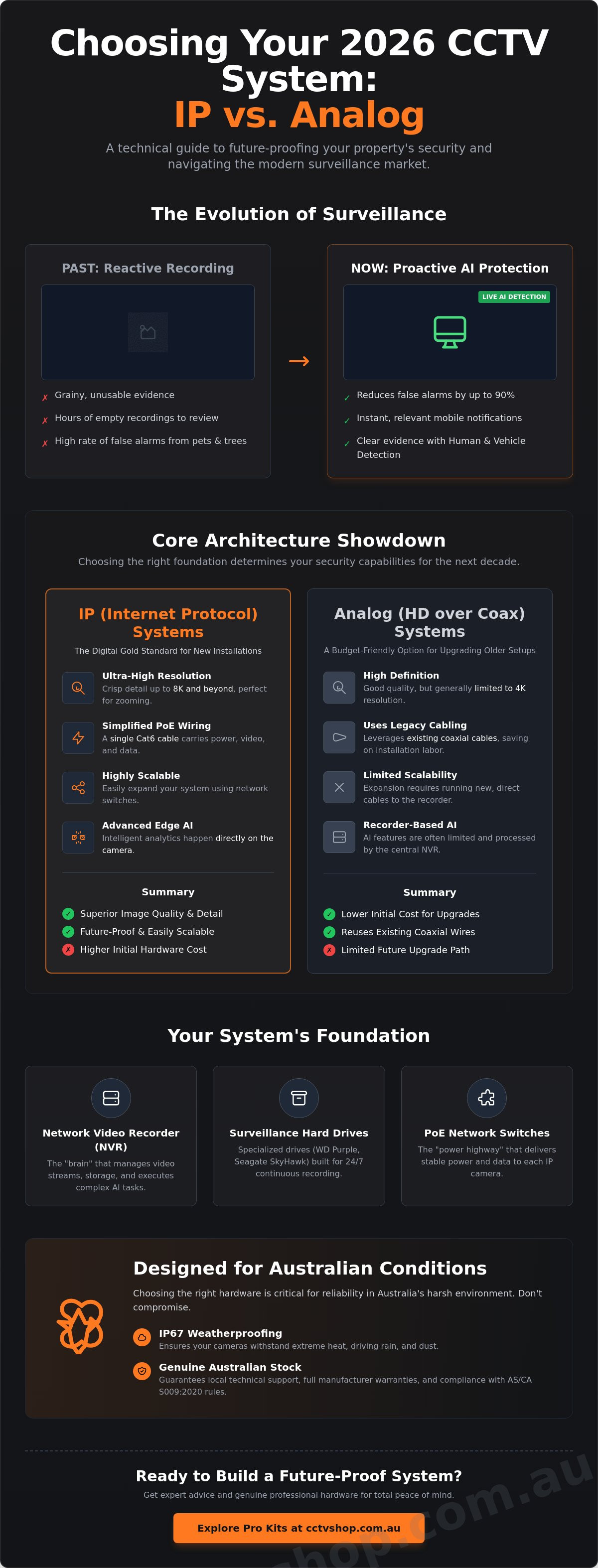
Professional surveillance has evolved beyond simple video capture. In 2026, Modern CCTV Camera Systems are integrated ecosystems designed to prevent incidents before they occur. Unlike the basic retail kits found in big-box stores, a professional system relies on the synergy between high-resolution optics, dedicated processing power, and robust infrastructure. This architecture ensures your security is proactive rather than reactive. By choosing professional grade hardware, you're investing in a solution that provides clear evidence and real-time protection rather than just a grainy record of a past event.
The gap between consumer-grade wireless kits and professional cctv camera systems is wider than ever. While all-in-one kits promise easy setup, they often suffer from signal interference and battery failure. Professional systems use hardwired Power over Ethernet (PoE) connections to guarantee 100% uptime and maximum data throughput. Sourcing genuine Australian stock is equally critical. It ensures your equipment is optimized for local conditions and backed by local technical support, which is a non-negotiable requirement for maintaining a reliable security perimeter over many years.
The Core Components of a 2026 Surveillance Setup
The Network Video Recorder (NVR) acts as the brain of your installation. It manages high-bandwidth data from multiple cameras and executes complex software tasks. To handle the massive data loads of 4K and 8K video, specialized surveillance hard drives like WD Purple or Seagate SkyHawk are essential. These drives are engineered for 24/7 continuous write cycles, unlike standard desktop drives that fail under the stress of constant recording. High-quality PoE switches further stabilize the system by providing a dedicated power highway for every camera on the network.
AI and Edge Analytics: The New Standard
Modern security isn't about watching hours of empty footage. AI-driven edge analytics now process data directly on the camera hardware to identify specific threats. This technology distinguishes between a swaying tree branch and a human intruder with incredible accuracy. By filtering out environmental noise, these cctv camera systems reduce false alarms by up to 90%. You receive instant, relevant notifications on your mobile device, allowing for immediate action. Because this processing happens "at the edge," it keeps your home or business network from becoming congested with unnecessary data traffic.
IP vs. Analog Systems: Which Architecture Should You Choose?
Choosing the right foundation for cctv camera systems determines your property's security capabilities for the next decade. The primary decision lies between IP (Internet Protocol) and Analog (HD-TVI/CVI) architectures. While both offer high-definition video, they differ significantly in how they transmit data and handle advanced AI features. IP systems represent the modern gold standard, delivering ultra-high definition resolutions like 8K that analog cables simply cannot match. If your goal is to capture crisp facial details or license plates at a distance, the digital precision of an IP network is the only logical path forward.
Analog systems still hold a place in the 2026 market, primarily for those retrofitting older buildings. These systems use existing coaxial cabling to deliver high-definition images, which saves on labor costs during installation. However, they lack the flexibility of their digital counterparts. Expanding an analog system often requires running new, bulky cables back to a central recorder, whereas IP systems allow for easier scaling through network switches. For those starting with a clean slate, the performance benefits of a digital setup far outweigh the initial savings of legacy hardware.
The Advantages of PoE IP Camera Systems
Power over Ethernet (PoE) technology has revolutionized how we install security hardware. A single Cat6 cable delivers power, video, and audio signals simultaneously, which eliminates the need for separate power supplies at every camera location. PoE stands as the most reliable DIY installation method in 2026 because it simplifies the wiring process while maintaining a stable, high-bandwidth connection. This architecture easily supports resolutions beyond 8MP, ensuring your footage remains usable even when digitally zoomed. If you're unsure which setup fits your floor plan, you can always seek expert advice from our local team to ensure a seamless deployment.
When to Consider Analog (HD-TVI/CVI) Systems
- Retrofitting: Ideal for properties where pulling new data cables through walls or ceilings is physically impossible or cost-prohibitive.
- Budget Constraints: Provides a lower entry price for basic surveillance where advanced AI analytics aren't the primary requirement.
- Simplicity: Useful for small-scale setups that only require local monitoring without complex network integration.
It's vital to understand that analog systems have clear limitations in the era of AI. While they can record video, they often struggle to support the heavy data processing required for advanced human and vehicle detection. This means you might miss out on the proactive alerts mentioned in the previous section. For most modern Australian homes and businesses, the shift toward IP is a necessary step for long-term reliability and future-proofing your cctv camera systems against evolving security threats.
Comparing the Giants: Hikvision vs. Dahua vs. HiLook
Selecting between the world's leading manufacturers often feels like splitting hairs, but technical nuances define your daily user experience. Hikvision and Dahua dominate the global market for professional cctv camera systems, while HiLook provides a gateway for those needing reliable security on a tighter budget. Each brand offers proprietary AI and imaging technologies designed to solve specific environmental challenges. Understanding these differences is the key to ensuring your investment remains relevant as surveillance technology advances through 2026.
Hikvision remains the global leader in innovation, particularly with its AcuSense technology. A professional Hikvision 6-camera kit, featuring 8MP ColorVu and 6MP AcuSense units with an 8K NVR, is priced at $2,549.00 AUD. This setup is the gold standard for users who prioritize maximum detail and intelligent filtering. Dahua provides a high-performance alternative with its WizSense and TiOC (Three-In-One Camera) lines. A comparable Dahua 6-camera kit, including 8MP IR and Full Colour TiOC cameras, is available for $1,688.00 AUD, offering exceptional value for those requiring active deterrence features like built-in sirens and strobe lights.
For residential applications where 4K resolution might be overkill, HiLook by Hikvision offers a budget-friendly entry point. These cameras range from 2MP to 6MP and utilize similar core technologies, such as ColorVu and basic human detection, without the premium price tag of the flagship series. While you can technically mix these brands using ONVIF protocols, we don't recommend it. Mixing manufacturers often breaks advanced AI analytics and forces you to use multiple mobile apps, which compromises the seamless experience of a unified system.
Hikvision AcuSense vs. Dahua WizSense
Both AcuSense and WizSense use deep learning algorithms to filter out up to 90% of false alarms caused by pets, wind, or heavy rain. The primary difference lies in the ecosystem. Hikvision's Hik-Connect app is often cited for its superior stability and ease of sharing, while Dahua's DMSS app provides more granular control over active deterrence settings. For commercial perimeters, Hikvision's deep learning tends to offer slightly more refined object classification, whereas Dahua's WizSense is a powerhouse for rapid search and playback of human or vehicle events.
Night Vision Technologies: ColorVu vs. Full-Color
The industry has moved away from the grainy, black-and-white infrared images of the past. Hikvision's ColorVu and Dahua's Full-Color systems use F1.0 large-aperture lenses to capture vivid detail in near-total darkness. When choosing your cctv camera systems, consider "Smart Hybrid" models. These units use discreet infrared for standard monitoring but instantly switch to white light LEDs when a human is detected. This approach provides full-colour evidence exactly when you need it while acting as a visual warning to intruders that they're being watched.
Designing Your System: Camera Styles and Australian Conditions
Designing a surveillance layout requires more than just picking high-spec cameras; it demands a strategy tailored to the harsh Australian environment. The "Australian Factor" is a critical consideration for cctv camera systems, as hardware must withstand temperatures exceeding 40 degrees Celsius and intense UV radiation. Ensuring your equipment carries an IP67 weatherproofing rating is non-negotiable. This rating guarantees the internal electronics remain sealed against both torrential rain and the fine dust common in rural and coastal areas. Without this protection, your investment will likely suffer from lens fogging or circuit failure within its first two summers.
Lens selection is the next pillar of effective design. A 2.8mm wide-angle lens is the standard for broad areas like backyards or open-plan offices, providing roughly 100 to 110 degrees of horizontal visibility. However, using a wide lens for a long driveway is a mistake. For these scenarios, a 4mm or 6mm narrow-angle lens is superior because it concentrates pixels on a smaller area, which makes it much easier to identify faces or number plates at a distance of 10 to 15 metres. Matching the focal length to the specific zone ensures your footage serves as usable evidence rather than just a general overview.
Camera Form Factors and Mounting
Turret cameras have become the preferred choice for Australian residential installations for a very practical reason: spiders. Unlike Dome cameras, Turrets don't have a large glass housing that reflects infrared light back into the lens when a spider spins a web across it. This prevents the "white-out" effect that often ruins night-time footage. Vandal-proof Dome cameras remain the standard for commercial settings with low ceilings where the hardware is within reach. For more detailed advice on residential layouts, see The Ultimate Guide to Choosing a Security System for Home Security in 2026.
Storage and Bandwidth Management
Recording 4K or 8K video generates massive amounts of data. To manage this, modern cctv camera systems utilize H.265+ compression, which reduces file sizes by up to 50% compared to older standards without sacrificing image quality. This efficiency is vital if you need to meet the 28-30 day data retention requirements common for Australian licensed venues. While motion-triggered recording saves space, we recommend continuous recording for high-risk areas to ensure you never miss the seconds leading up to an event. You can explore more technical specifications in The Definitive Guide to Video Surveillance Security Cameras in 2026.
Building a system that survives the elements and provides clear evidence requires the right mix of housing styles and storage capacity. If you're ready to secure your property with hardware built for local conditions, you can browse our range of Australian-certified kits to find the perfect fit for your floor plan.
Why Source Your CCTV System from CCTV Shop?
Investing in professional cctv camera systems is a significant commitment to your property's long-term safety. Choosing where to buy that equipment is just as important as the hardware itself. We're 100% Australian-owned and operated. This ownership means our technical team understands the specific security challenges faced by local homeowners and businesses, from coastal salt spray to the intense heat of the outback. We don't just sell boxes; we provide a layer of professional consultation that ensures your system is configured correctly from day one.
Sourcing your hardware locally eliminates the common frustrations associated with international retailers. We provide genuine Australian stock backed by full local manufacturer warranties. If a component fails, you won't have to deal with overseas shipping or language barriers. You'll speak with an Australian specialist who can troubleshoot the issue or facilitate a rapid replacement. This commitment to reliability is why we've become the trusted partner for both DIY enthusiasts and professional security installers across the country.
The CCTV Shop Difference
Grey market imports are a major risk in the security industry. These units often arrive with hacked firmware that cannot be updated, leaving your network vulnerable to cyber threats. Our cctv camera systems are guaranteed genuine, ensuring you receive every official security patch and feature update as they're released. We ship everything from our Western Australian hub, providing fast nationwide delivery so your project stays on schedule. For a deeper look at why your choice of supplier matters, read our guide on Choosing the Right Security Wholesalers: A 2026 Guide for Australian Professionals.
Getting Started with Your Security Upgrade
We've designed our purchase process to be as seamless as the systems we sell. Our online kit builders allow you to customize your surveillance package, ensuring you get the exact mix of turret, dome, or bullet cameras required for your floor plan. If you're tackling a professional DIY setup, you'll have access to our comprehensive library of technical resources and lifetime support. For larger commercial projects, our specialists are available to provide custom quotes and detailed site analysis. We're here to help you move from a state of uncertainty to total visibility and peace of mind. Contact us today to discuss your requirements or use our online tools to build your ideal security solution.
Secure Your Perimeter with Professional Certainty
The landscape of surveillance has shifted from simple video recording to intelligent, proactive perimeter protection. By choosing modern cctv camera systems, you're investing in high-resolution optics and AI algorithms that distinguish between a genuine threat and environmental noise. Whether you opt for the innovation of Hikvision or the performance value of Dahua, the key to a successful deployment lies in selecting hardware built for the Australian climate. This choice ensures your storage remains reliable and your night-time visibility is crystal clear for years to come.
Don't leave your property's safety to chance with unverified imports or consumer-grade retail kits. We provide 100% Australian owned and operated service, offering expert technical support and genuine Hikvision and Dahua stock. Our team is ready to help. We'll guide you through technical specifications to find a solution that offers total visibility and control. You'll gain the peace of mind that comes from a system designed to work when it matters most.
Browse Our Professional CCTV Camera Systems today and take the first step toward a more secure future.
Frequently Asked Questions
What is the best CCTV camera system for a home in 2026?
The best solution for most Australian homes is a 4K IP-based PoE system from a reputable brand like Hikvision or Dahua. These cctv camera systems offer the ideal balance of ultra-high definition clarity and intelligent AI filtering. You should look for models featuring human and vehicle detection, such as the AcuSense or WizSense series, to ensure you only receive notifications for genuine security events rather than pets or weather.
Can I install a professional CCTV system myself?
You can perform the physical mounting and configuration of a professional system, but specific Australian regulations apply to the cabling. Under the AS/CA S009:2020 Wiring Rules, any fixed data cabling within walls or ceilings must be installed by a person with a current Open Cabler Registration. While many homeowners choose a DIY approach for the software setup, hiring a licensed professional for the infrastructure ensures your installation is compliant and safe.
Do CCTV systems require a monthly subscription?
Professional NVR-based systems don't require a monthly subscription for core functionality. Unlike consumer-grade cloud cameras that charge for storage, professional cctv camera systems record directly to an internal surveillance-grade hard drive. You'll have full access to remote viewing, AI alerts, and historical footage through official apps like Hik-Connect or DMSS without any ongoing fees or hidden service costs.
How much storage do I need for 4 cameras recording in 4K?
You'll typically need a 6TB or 8TB surveillance hard drive to store approximately 14 to 21 days of continuous 4K footage. This estimate assumes you're using modern H.265+ compression, which reduces data usage by roughly 50% compared to older formats. If you only record during motion events, a 4TB drive can often provide several months of history, though continuous recording is safer for critical evidence gathering.
What is the difference between an NVR and a DVR?
An NVR (Network Video Recorder) is used with digital IP cameras, while a DVR (Digital Video Recorder) is designed for older analog or HD-TVI systems. The NVR is the modern standard because it receives a digital signal that has already been processed by the camera. This allows for higher resolutions and more advanced AI analytics. DVRs process the raw analog signal at the recorder, which often limits image quality and feature sets.
Are wireless security cameras as good as wired PoE systems?
Wired PoE systems are significantly more reliable than wireless alternatives for professional security. Wireless cameras are prone to signal interference, limited bandwidth, and battery failure, which can lead to missed recordings at critical moments. A wired Cat6 connection provides a stable data highway and consistent power. This ensures your cameras can maintain a high-bitrate 4K stream 24/7 without the dropouts common in Wi-Fi setups.
How can I view my CCTV cameras on my phone while away from home?
Remote viewing is achieved by connecting your NVR to your home internet and using the manufacturer's secure P2P mobile application. Once you've scanned the QR code on your recorder, you can view live streams and playback footage from anywhere in the world. These apps use encrypted tunnels to ensure your video remains private while providing instant push notifications whenever your cameras detect a person or vehicle on your property.
What happens to my CCTV system during a power outage?
Your system will shut down immediately during a power outage unless it's protected by an Uninterruptible Power Supply (UPS). We recommend using a 1500VA or 2000VA UPS to keep a standard 4-camera system running for approximately 30 to 60 minutes. This backup window is vital for maintaining security during short blackouts and protects your NVR's sensitive hard drive from data corruption caused by sudden power loss.