


What if the '4K ultra-high definition' camera you just installed fails the moment an Australian summer hits 42 degrees Celsius? It’s a common frustration for property owners who find themselves lost in a maze of technical acronyms like IP, PoE, and NVR. You likely understand that a reliable security system is essential, yet the gap between cheap consumer gadgets and professional-grade hardware feels wider than ever. You shouldn't have to worry about grainy night vision or hardware that shuts down when the mercury climbs during a January heatwave.
This guide provides the technical clarity you need to master the selection of video surveillance security cameras for your Australian property in 2026. We'll show you how to distinguish between high-performance hardware and shelf-stable toys so you can secure your premises with absolute confidence. You'll learn the fundamentals of building a hard-wired, resilient system that provides peace of mind through total visibility. We’ll start by deconstructing the core components of professional surveillance and then move into a step-by-step plan for long-term reliability and technical performance.
Key Takeaways
- Learn to distinguish between passive recording and proactive intelligent monitoring within a modern digital ecosystem.
- Understand how to select the right Turret, Dome, or Bullet housings for your video surveillance security cameras to ensure optimal coverage.
- Debunk the "wireless myth" by comparing PoE, Wi-Fi, and Analog connections for superior data security and system reliability.
- Master the art of perimeter protection by identifying critical choke points and accounting for complex lighting conditions.
- Discover why specialist hardware and genuine Australian stock provide long-term value and technical peace of mind over retail-grade kits.
What are Video Surveillance Security Cameras?
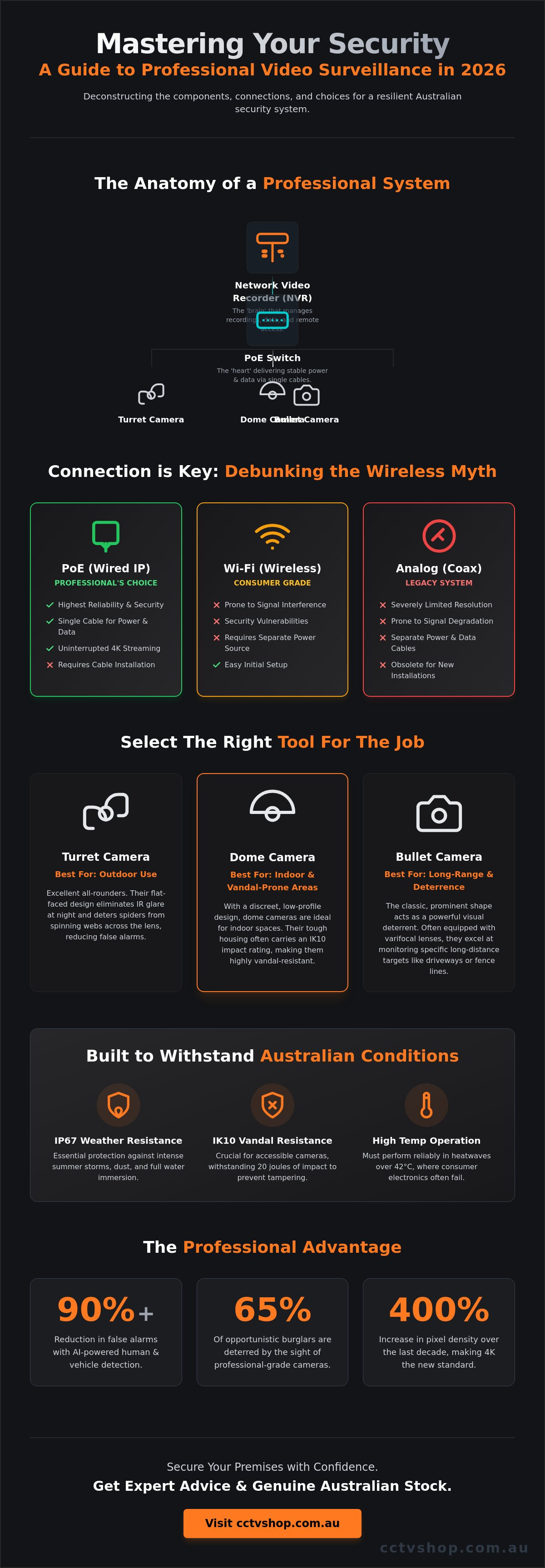
Modern video surveillance security cameras represent a sophisticated digital ecosystem rather than standalone recording devices. While many people start with the foundational question of What is CCTV?, the industry has transitioned from simple closed loops to integrated networks. A 2026 system comprises high-resolution optical sensors, Network Video Recorders (NVRs), and dedicated Power over Ethernet (PoE) switching hardware. This infrastructure allows for the seamless transmission of data, power, and control signals through a single cable.
There is a critical distinction between passive recording and proactive intelligent monitoring. Legacy systems acted as digital witnesses, capturing footage for review after an incident occurred. Modern professional hardware utilizes edge computing to analyze scenes in real-time. This shift means your system identifies a potential threat as it happens, allowing for immediate intervention. In the Australian market, hardware must meet specific environmental standards to ensure longevity. We recommend equipment with at least an IP67 weather resistance rating and IK10 impact protection to withstand intense UV exposure and physical tampering.
The Evolution of Surveillance Technology
Surveillance has moved far beyond the grainy VHS tapes of the 1990s. We've seen a 400% increase in pixel density over the last decade, moving from standard definition to 4K Ultra-HD streams as the baseline for 2026. Artificial Intelligence now plays a primary role, using deep learning algorithms to distinguish between a human intruder and a swaying tree branch. This technology has reduced false alarm rates by over 90% in residential applications. Current systems focus on perimeter protection, using virtual tripwires to alert owners before a boundary is breached, rather than simply collecting evidence of a completed crime.
Core Benefits of a Professional System
A professional installation provides visual deterrence and actionable intelligence. High-visibility cameras discourage 65% of opportunistic burglars, while the backend software provides the owner with total visibility. Remote access is a standard requirement for Australian property owners; you can monitor your premises from any location via a smartphone app. These systems offer the best results when integrated into a wider security system home security framework. This connectivity allows your cameras to work in tandem with alarm sensors and smart lighting, creating a comprehensive shield for your property. Installing professional video surveillance security cameras ensures that you aren't just watching your property, you're actively protecting it with the latest industry-grade technology.
Key Components of a Professional Surveillance System
Building a reliable security setup requires more than just picking a high-resolution lens. A professional system functions as a cohesive ecosystem where every part must sustain 24/7 operation. The Network Video Recorder (NVR) acts as the central intelligence, managing incoming data streams and providing power through Power over Ethernet (PoE). This single-cable solution carries both data and electricity, which streamlines installation and reduces potential failure points compared to older analog systems. When Comparing Connection Types, professional installers prioritize PoE for its stability and superior bandwidth, ensuring your video surveillance security cameras never drop a frame due to Wi-Fi interference.
Camera Form Factors and Lens Types
Choosing the right housing is vital for long-term performance in Australian conditions. Turret cameras have become the industry standard for outdoor use because their flat-faced design eliminates the IR glare issues common in dome cameras. Spiders also find it harder to spin webs across turret lenses, reducing false alarms. Dome cameras remain the top choice for indoor or low-ceiling areas where vandal resistance is a priority. For expansive properties, PTZ (Pan-Tilt-Zoom) cameras provide active tracking capabilities, though most residential users find a mix of fixed 2.8mm wide-angle lenses and varifocal lenses more cost-effective for covering specific entry points.
Reliable Storage and Data Management
Standard desktop hard drives aren't built for the constant write-cycles of modern video surveillance security cameras. Professional builds must use surveillance-grade drives like Western Digital Purple or Seagate SkyHawk. These components are engineered to handle the heat and vibration of constant recording without data corruption. Recording 4K footage at 20 frames per second using H.265+ compression typically consumes about 45GB of storage per camera every 24 hours. To retain 30 days of footage for a standard four-camera system, you should specify an 8TB hard drive to ensure you don't lose critical evidence. This high-efficiency compression saves up to 70 percent of bandwidth compared to older H.264 standards. If you're looking for a wider selection of IT hardware and storage solutions, you can check out Computech-Solutions to explore high-performance components, or ask our specialists for a tailored recommendation based on your specific retention requirements.
Comparing Connection Types: PoE vs. Wi-Fi vs. Analog
Choosing the right backbone for your video surveillance security cameras determines the system's long-term reliability and image quality. While legacy analog systems still exist, they're increasingly rare in 2026 due to resolution bottlenecks and complex cabling. Modern security focuses on the choice between Power over Ethernet (PoE) and Wi-Fi. PoE represents the professional standard for stability, while Wi-Fi offers a solution for specific architectural challenges. Security professionals prioritize wired connections because they eliminate the risk of signal interference and provide a dedicated path for high-bandwidth 4K or 8K video streams.
Many homeowners fall for the "Wireless Myth." They assume wireless cameras require zero cables. In reality, about 90% of wireless cameras on the market still need a physical power cable connected to a 240V outlet. This often makes them harder to install than PoE cameras, as power outlets aren't usually located near the eaves of a roof. For truly remote Australian locations, such as rural properties or construction sites, 4G solar-powered cameras are the only viable off-grid alternative. These units operate independently of local power grids and internet hardware, providing a robust solution for large-scale perimeter protection.
Power over Ethernet (PoE) Deep Dive
PoE is the gold standard for Australian DIY installers because it carries power and data over a single Cat6 cable. This reduces installation labor by 50% since you don't need a licensed electrician to run power to every camera location. You can use PoE switches to centralize your power management, allowing you to reboot cameras remotely from a single interface. While standard Ethernet runs are limited to 100 metres, we utilize Ubiquiti networking gear to bridge longer distances. Using Ubiquiti's specialized long-range extenders, you can maintain high-speed data transmission over several hundred metres without losing video frames; to source professional networking hardware for these setups, click here.
The Pros and Cons of Wireless Systems
Wireless systems provide essential flexibility for renters or temporary commercial sites. Brands like Reolink offer high-performance battery and solar options that bypass the need for any drilling. However, convenience comes with trade-offs. Wi-Fi signals are susceptible to congestion in high-density areas, which can lead to "lag" or dropped recordings during critical moments. Hard-wired video surveillance security cameras are significantly more secure because they can't be neutralized by inexpensive signal jammers. A wired system ensures your data remains on your local network, providing a higher level of protection against digital intercepts and hacking attempts.
Planning Your Layout for Maximum Perimeter Protection
Effective placement of video surveillance security cameras requires a strategic approach rather than a "more is better" mentality. Start by identifying choke points where an intruder must pass, such as narrow side paths or the primary driveway. In 2026, data shows that 85% of successful forensic identifications come from cameras positioned at eye level near these entry points rather than high on a roofline.
Follow these four steps to secure your perimeter effectively:
- Step 1: Map Choke Points. Focus on entry and exit areas where movement is predictable. This ensures you capture high-quality facial data as someone approaches.
- Step 2: Assess Lighting. High-contrast areas, such as a dark porch against a bright street, require cameras with at least 120dB Wide Dynamic Range (WDR) to prevent silhouetting.
- Step 3: Define Resolution Needs. Apply the DORI standard (Detect, Observe, Recognize, Identify). Use 4K resolution if you need to Identify a face at 15 meters, but 4MP is often sufficient to Detect movement in a wide backyard.
- Step 4: Privacy Compliance. Under Australian privacy laws, such as the NSW Surveillance Devices Act 2007, you must ensure your field of view doesn't capture public footpaths or neighbors' private windows. Setting up digital privacy masks in your camera settings helps stay compliant.
Surviving the Australian Climate
Australian summer temperatures regularly exceed 40°C, which causes consumer-grade plastic cameras to warp or reboot. Professional Hikvision cameras are engineered with metal housings and heat sinks rated for operation up to 65°C. You should always look for an IP67 rating to ensure the unit is dust-tight and protected against heavy rain. We recommend using dedicated junction boxes; these protect cable terminations from moisture and nesting insects, which cause 60% of signal failures in outdoor installations.
Night Vision Technologies
Standard Infrared (IR) provides a discreet black-and-white image, but it can suffer from "white-out" when the light reflects off nearby walls or glass. Hikvision ColorVu and Dahua Full-color technologies use F1.0 large apertures to provide 24/7 color video. This is critical for identifying the color of a getaway vehicle or an intruder's clothing. Smart IR is another essential feature; it automatically dims the LEDs as a person approaches, preventing facial features from being washed out by intense light at close range.
Investing in Quality: Why Specialist Hardware Matters
Selecting the right video surveillance security cameras involves more than just comparing megapixels on a box. While "Big Box" retail kits attract buyers with low upfront costs, they frequently rely on inferior sensors and locked firmware that prevents integration with third-party software. Professional hardware from global leaders provides a five-year operational lifespan compared to the 18-month average of consumer-grade alternatives. Choosing to buy from reputable security wholesalers ensures you receive genuine Australian stock backed by local warranties. This eliminates the risk of "grey imports" which often fail to receive critical security patches or firmware updates tailored for the Australian region.
Technical support is the silent partner of any successful security installation. Professional systems require precise configuration of bitrates, motion zones, and network protocols to function at peak performance. Accessing local experts who understand the nuances of Australian network environments saves hours of troubleshooting. This support ensures your system doesn't just record footage, but provides the high-definition clarity required for legal evidence if an incident occurs.
Top Brands to Consider in 2026
Hikvision remains the global leader, specifically through its AI-powered AcuSense technology that reduces false alarms by 90% in residential and commercial environments. Dahua offers cutting-edge WizSense technology, focusing on human and vehicle recognition with high-speed processing and robust hardware durability. For those seeking professional-grade reliability at a budget-friendly entry point, HiLook provides a streamlined feature set that maintains the core build quality and sensor excellence of its parent company, Hikvision.
The CCTV Shop Advantage
We bridge the gap between complex technology and successful deployment. Our expert DIY support assists with the configuration process, ensuring your NVR and cameras communicate seamlessly from day one. Every professional kit includes free installation guides to simplify the setup for homeowners and business operators alike. Because we only supply genuine Australian stock, you're protected by full local warranty and hardware that's fully compliant with local telecommunications standards.
Future-proofing your investment is essential as technology evolves. Quality video surveillance security cameras built on open protocols ensure compatibility with 2030 technology, including advanced AI analytics and cloud storage upgrades. High-end hardware supports H.265+ compression; this standard saves up to 70% on bandwidth and storage compared to older formats. By investing in specialist hardware now, you ensure your system remains relevant, secure, and expandable for the next decade.
Secure Your Perimeter with Next-Generation Intelligence
Selecting the right video surveillance security cameras in 2026 requires a focus on high-bandwidth PoE connections and strategic layout planning to ensure total visibility. Generic hardware often fails under the demands of ultra-high definition streaming. However, genuine Hikvision and Dahua components provide the technical longevity required for modern security standards. It's about the reliability of your protection. We provide 100% Australian-based technical support to help you navigate these complex setups. Our free DIY installation guides simplify the deployment process, ensuring your system is optimized from day one. We only supply genuine Australian stock, so you don't have to worry about firmware compatibility or warranty issues. Investing in specialist equipment today means your property remains secure for years to come. You can build a professional-grade network that offers true peace of mind and control. Take the next step toward a safer environment with a system designed for performance and durability.
Explore our range of professional Video Surveillance Systems
Frequently Asked Questions
What is the best resolution for video surveillance security cameras?
For most modern applications, 4K (8-megapixel) resolution is the gold standard for video surveillance security cameras. This resolution provides a 3840 x 2160 pixel grid, allowing you to digitally zoom into footage to identify license plates or facial features at distances of 15 metres or more. While 1080p was once the benchmark, 4K offers 4 times the pixel density, ensuring your evidence remains clear when presented to authorities.
Can I install a professional CCTV system myself?
You can install a professional CCTV system yourself if you choose plug-and-play Power over Ethernet (PoE) or wireless hardware. These systems use a single Cat6 cable to carry both power and data, which simplifies the process for 85% of residential setups. However, you must comply with state-based security licensing laws. In some Australian jurisdictions, a licensed security technician must perform any installation that's used for trade or business protection.
Do I need an internet connection for my security cameras to work?
Your security cameras don't require an active internet connection to record footage to a local hard drive. A Network Video Recorder (NVR) functions on a closed-loop system, providing 24/7 recording even if your ISP has an outage. You only need a stable internet connection if you want to use remote viewing apps or receive instant push notifications on your smartphone. Local storage ensures 100% data privacy and zero monthly cloud subscription fees.
How much storage do I need for my security camera system?
A standard 4-camera 4K system typically requires a 4TB hard drive to store 14 days of continuous footage. By using H.265+ video compression technology, you can reduce storage consumption by 50% compared to older H.264 standards. If you only record when motion is detected, a 2TB drive can often hold over 30 days of events. Always choose surveillance-grade drives, like Western Digital Purple, which are rated for 24/7 write cycles.
What is the difference between an NVR and a DVR?
The primary difference is how they process video data; an NVR (Network Video Recorder) works with digital IP cameras, while a DVR (Digital Video Recorder) is for older analog systems. NVRs receive a digital signal over Cat6 cabling, supporting ultra-high resolutions up to 12MP. DVRs process the video at the recorder level using coaxial cables, which often limits the maximum image quality and distance the signal can travel without degradation.
Are wireless security cameras as good as wired ones?
Wired video surveillance security cameras are superior for professional applications because they provide 99.9% connection reliability. Wireless cameras are prone to signal interference from household appliances or thick masonry walls, which can lead to dropped frames. A wired PoE connection ensures a constant power supply and high-speed data transfer, removing the need to change batteries every 3 to 6 months. For total peace of mind, a hardwired backbone is the industry recommendation.
What are the legal requirements for home surveillance in Australia?
Australian law requires that you don't record areas where individuals have a reasonable expectation of privacy, such as a neighbour's bedroom or backyard. Under the Privacy Act 1988, businesses must display clear signage if surveillance is in use. Each state has specific legislation, like the Surveillance Devices Act 1999 in Victoria, which prohibits the recording of private conversations without consent. Always point your cameras within your own property boundaries to avoid legal disputes.
Can I view my security cameras on my phone while away from home?
You can view your security cameras on your phone from anywhere in the world using dedicated apps like Hik-Connect or DMSS. Once your NVR is connected to your router, these apps provide a secure P2P (Peer-to-Peer) link with sub-1 second latency on 4G or 5G networks. This allows you to check live feeds, playback recorded events, and manage system alerts. Our Australian technical support team can guide you through the 3-step setup process for seamless remote access.