


A security camera that shuts down when the mercury hits 40°C isn't a security tool; it's a liability. You've likely spent hours decoding terms like PoE, NVR, and AcuSense, only to feel more frustrated than when you started. It's common to worry that a security system home security investment might fail exactly when you need it most, or worse, plague you with false alarms at 2:00 AM because of a passing moth. You want technical reliability, not a new hobby in troubleshooting hardware that wasn't built for local conditions.
You deserve a setup that offers total visibility without the headache of constant maintenance. This guide will help you master the technical essentials of professional-grade surveillance to build a system that provides absolute protection and peace of mind. We'll break down complex system architecture, identify the top-tier brands engineered for the Australian sun, and provide a clear blueprint for your DIY professional setup. By the end, you'll have the confidence to secure your property with hardware that actually delivers on its promise.
Key Takeaways
- Understand why Power over Ethernet (PoE) is the gold standard for reliability in Australian homes, bypassing the signal interference common with wireless systems in brick or tin-roof properties.
- Learn how to select the right Network Video Recorder (NVR) and surveillance-grade storage to build a high-performance security system home security ecosystem that never misses a frame.
- Discover how AI-driven technologies like AcuSense and ColorVu eliminate false alarms and provide full-colour evidence, even in total darkness.
- Distinguish between basic consumer "smart" cameras and professional-grade hardware to ensure your property has genuine, integrated perimeter protection rather than just simple monitoring.
- See why sourcing from Australian specialists provides the advantage of local technical support and genuine stock, ensuring your DIY configuration is backed by expert guidance.
What is a Professional Home Security System in 2026?
By 2026, the definition of a professional security system home security solution has moved far beyond simple standalone cameras or basic motion sensors. Today, a professional system is a sophisticated, integrated network of IP-based hardware designed for 24/7 reliability. Unlike consumer-grade "smart home" cameras that rely on congested home Wi-Fi and unstable cloud subscriptions, professional systems utilize dedicated Power over Ethernet (PoE) cabling and local Network Video Recorders (NVRs). This ensures that high-resolution data remains secure and recording never drops out due to a weak internet signal.
The Australian market has seen a distinct shift toward these high-end architectures. While retail kits offer a basic overview of security alarm systems and their history, they often lack the processing power required for modern analytics. Professional hardware is built with industrial-grade components designed to withstand the harsh Australian climate, ensuring your investment lasts for a decade rather than a few seasons. Choosing local Australian stock is vital for this longevity. It guarantees that your equipment carries a valid local warranty and that you have access to expert technical support when configuring complex network settings.
The Core Philosophy: Prevention vs. Evidence
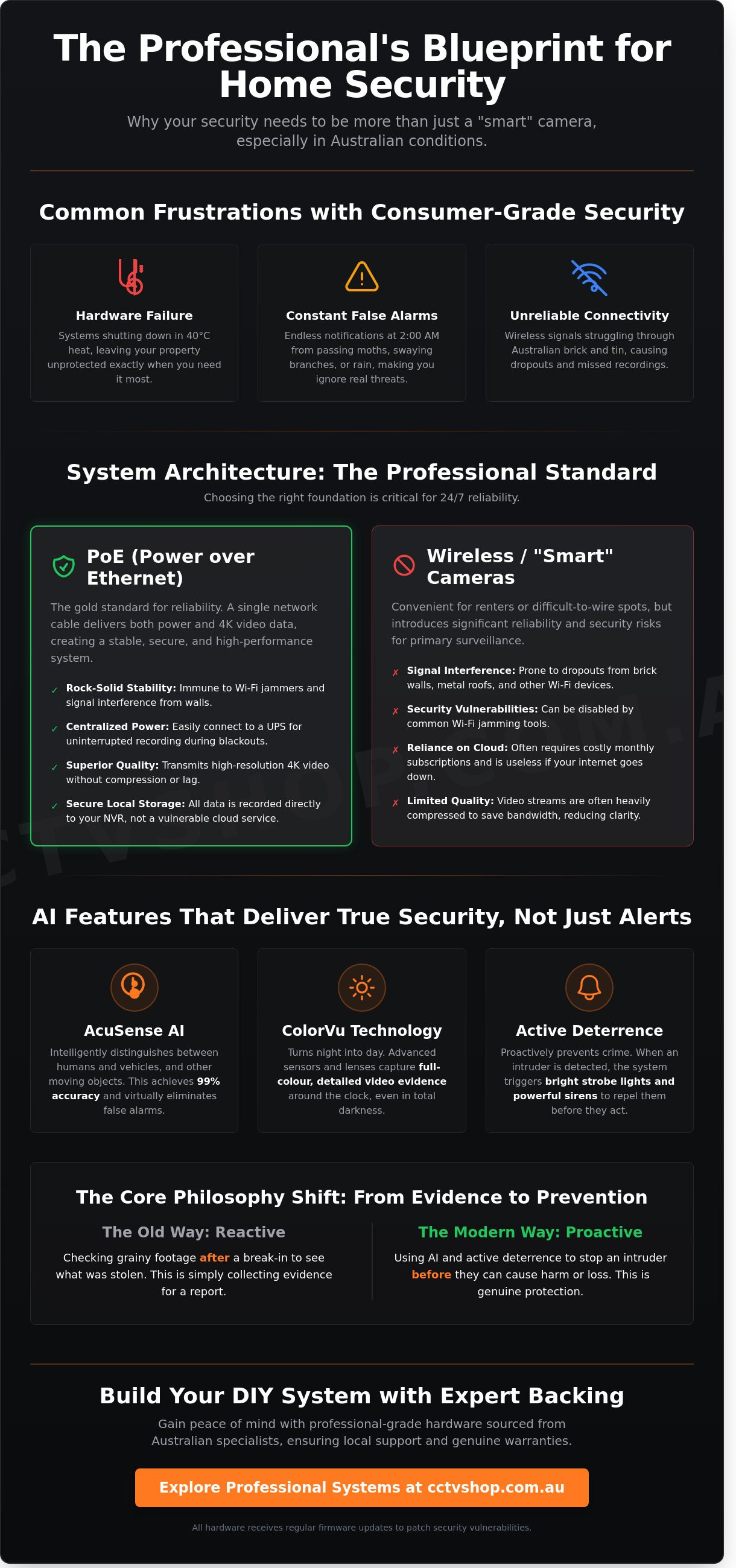
Modern security focuses on stopping a crime before it occurs. In previous years, home security was reactive; you checked the footage after a break-in to see what was stolen. In 2026, the priority is proactive perimeter protection. Advanced AI algorithms now distinguish between a stray cat, swaying branches, and a human intruder with 99% accuracy. This precision allows systems to trigger immediate responses the moment someone crosses a virtual boundary. Active Deterrence is a proactive security layer that uses immediate sensory triggers, like sirens and strobe lights, to repel intruders the moment a perimeter breach is detected. This shift ensures your security system home security strategy prioritizes your family's safety over merely collecting evidence for a police report.
Why Professional Brands Matter for Home Security
Top-tier brands like Hikvision and Dahua dominate the professional landscape because they invest billions into research and development. These manufacturers provide features that retail brands can't match, such as ultra-low-light imaging that turns night into day without needing massive floodlights. When you choose professional-grade components, you're investing in hardware that receives regular firmware updates to patch security vulnerabilities. For DIY installers, the value of these brands is amplified by the availability of expert technical support. At CCTV Shop, we provide the bridge between high-end commercial technology and residential application, ensuring you have the right advice to set up a system that provides genuine peace of mind.
PoE vs. Wireless: Choosing Your System Architecture
Selecting the structural foundation of your security system home security setup is a decision between hardwired stability and wireless flexibility. While wireless technology reached new heights of convenience by 2024, PoE remains the undisputed professional standard for 24/7 surveillance in 2026. This choice dictates not just how your cameras look, but how they perform during a critical event. You should consider these home security tips from university police when deciding how much physical infrastructure your property requires to remain truly secure.
The Case for PoE (Power over Ethernet)
PoE technology uses a single Cat6 cable to transmit 4K video data and electrical power simultaneously. This architecture eliminates the need for a qualified electrician to install power outlets at every camera point, which can save hundreds in installation labor. Because every camera connects back to a central Network Video Recorder (NVR) or a PoE switch, you gain a unified power source. This makes it simple to add an Uninterruptible Power Supply (UPS) that keeps the entire system running during a blackout. Wired systems are also immune to Wi-Fi signal jamming devices, which have become a known tool for sophisticated intruders in recent years.
When to Use Wireless or Solar Cameras
Wireless and solar cameras serve a specific purpose for Australian renters or those with expansive rural boundaries. They're perfect for a "set and forget" approach in remote corners where trenching cables isn't feasible. Brands like Reolink have perfected solar-integrated models that maintain a charge even with moderate cloud cover. However, there's a trade-off. Battery-powered models often rely on PIR sensors that only wake the camera when motion is detected, meaning you might miss the first few seconds of an event. In high-traffic areas, a battery that's rated for six months might actually deplete in 20 days if it's triggered constantly by street traffic or pets.
Performance in the Australian Climate
The Australian climate is notoriously harsh on electronic components. Extreme heat in 40-degree summers can cause lithium-ion batteries in wireless cameras to degrade or swell over time. Hardwired PoE systems handle these temperatures more effectively because the sensitive power management components are housed indoors within the NVR. For any external cable runs, we strictly use UV-rated, outdoor-grade cabling to prevent the insulation from cracking under the intense sun. If you're planning to install your NVR in a cupboard or a roof loft, ensure the space has adequate ventilation. Thermal management is vital for the longevity of your hard drives and processing chips.
The total cost of ownership for a PoE system is usually lower over a five-year period. You avoid the recurring expense of battery replacements and the potential downtime caused by Wi-Fi interference in homes with double-brick walls or Colorbond roofing. If you're unsure which architecture fits your specific floor plan, you can always request expert advice from our local technical team to ensure your security system home security investment is built to last.
Essential Components of a Reliable Home Security System
Building a robust security system home security setup requires more than just high-resolution lenses. It involves a coordinated ecosystem where every component, from the storage drive to the mounting bracket, must meet professional standards to ensure 24/7 reliability. A failure in any single part of this chain can result in lost footage when you need it most. By selecting hardware designed specifically for surveillance, you move from a basic deterrent to a high-performance evidentiary tool.
Selecting the Right NVR
The Network Video Recorder (NVR) serves as the brain of your entire installation. When choosing an NVR, you must match the channel count to your current and future requirements. A 4-channel unit is suitable for small units, but an 8 or 16-channel recorder provides the necessary headroom for expanding your coverage later. You also need to verify the incoming bandwidth limits. High-bitrate 4K and 8K camera streams can quickly saturate a low-end NVR, causing lag or dropped frames. For modern Australian homes, we recommend recorders that support remote access via Hik-Connect or DMSS, allowing you to view live feeds and receive push notifications directly on your smartphone.
The Importance of Surveillance-Rated Storage
Storage is the most frequent point of failure in DIY systems because users often repurpose standard computer hardware. Surveillance environments demand 24/7 write-cycles, which generate significant heat and mechanical wear. Brands like WD Purple and Seagate SkyHawk are engineered to handle these constant workloads without degradation. Standard PC drives will fail prematurely in an NVR. When calculating your storage needs, remember that a single 4K camera recording at 20 frames per second can consume over 60GB of data per day. To maintain a 30-day archive for a four-camera security system home security setup, you should look at a minimum of 8TB to 10TB of dedicated surveillance storage.
Cabling and Mounting Essentials
The physical installation quality determines the longevity of your hardware. While Cat5e is technically sufficient for many setups, Cat6 cabling is the preferred choice for long-distance Power over Ethernet (PoE) runs because its thicker copper cores reduce voltage drop. This ensures your cameras receive stable power even at the 100-metre limit. For the cameras themselves, form factor choice is functional rather than just aesthetic:
- Turret Cameras: These are the industry favourite for night vision performance as their design prevents "IR bleed" into the lens.
- Dome Cameras: These offer superior vandal resistance, making them ideal for low-ceiling entries where the unit is within reach.
- Bullet Cameras: These act as a strong visible deterrent and are often used for long-range monitoring of driveways.
Regardless of the shape, using weatherproof junction boxes is non-negotiable. These boxes protect the RJ45 connection from moisture and corrosion, which are the leading causes of "camera offline" errors in the Australian climate. You can find more detailed comparisons in our guide to home security cameras. For larger properties, integrating Ubiquiti networking gear or high-grade PoE switches ensures your data reaches the NVR without bottlenecking.
Advanced Features: AI, Night Vision, and Resolution
Modern hardware has moved far beyond simple video recording. Today's security system home security setups rely on deep learning to distinguish between a stray cat and a genuine intruder. Implementing these advanced features ensures your system provides actionable intelligence rather than just a library of useless footage. By 2026, the focus has shifted from mere visibility to precision detection and 24/7 colour clarity.
Understanding Human and Vehicle Detection
Deep learning algorithms like Hikvision's AcuSense and Dahua's WizSense have changed how we manage alerts. These systems effectively filter out up to 90% of false alarms caused by heavy rain, swaying foliage, or pets. By focusing specifically on human and vehicle silhouettes, your NVR only sends a notification when a real threat is present. You can set up digital fences using line crossing and intrusion zones to protect specific areas like your front porch or side gate. For a detailed breakdown of these AI capabilities, check this Dahua guide for WizSense specifics.
Night Vision Technologies Compared
Standard Infrared (IR) night vision remains a reliable staple, providing clear black and white imagery in total darkness. However, the industry is moving toward full-colour solutions. Technologies like Hikvision ColorVu use large f/1.0 apertures and warm supplemental lighting to capture vivid colour video even at 2:00 AM. This detail is vital for identifying the colour of a vehicle or a suspect's clothing. While ColorVu is perfect for suburban streets with some ambient light, standard IR is often better for pitch-black rural properties where visible supplemental light might be distracting to neighbours.
Resolution and Field of View
It's a common misconception that higher resolution is always superior. While 4K (8MP) or even 12MP cameras offer incredible detail for wide driveways, they demand significant storage space and high-speed internet. For most Australian homes, 4MP remains the "sweet spot" for a security system home security plan. These sensors often perform better in low light than 4K sensors because the individual pixels are larger, allowing them to capture more light. Only invest in 4K or 8K when you need to digitally zoom in on distant objects, such as a license plate at the end of a long driveway.
- Two-way talk: Use built-in speakers to challenge intruders or speak to delivery drivers.
- High-fidelity mics: Capture environmental sounds like breaking glass for better evidence.
- Smart search: Quickly find footage by filtering for "human" or "vehicle" events.
Choosing the right combination of AI and resolution depends entirely on your property's layout and lighting. Speak with our Australian technical team to find the perfect hardware balance for your home.
Building Your System with a Trusted Specialist
Selecting the right hardware for a security system home security project is only half the battle. The partner you choose to supply that equipment determines the long-term reliability of your protection. Many homeowners make the mistake of purchasing consumer-grade kits from big-box retailers. These "plug-and-play" systems often rely on proprietary clouds that compromise privacy or lack the processing power for accurate AI detection. Choosing to buy from security wholesalers ensures you access professional-grade equipment designed for 24/7 operation.
One of the most critical factors in 2026 is ensuring your hardware is genuine Australian stock. Grey market imports might look identical on the surface, but they often come with overseas firmware that cannot be updated. This leaves your network vulnerable to cyber threats. Genuine Australian stock guarantees that your NVR and cameras receive local security patches and firmware updates, keeping your system functional and secure for years. It also ensures your warranty is enforceable within Australia, providing a safety net that international resellers cannot match.
The DIY Advantage with Professional Support
CCTV Shop bridges the gap between expert-level hardware and home installation. You don't need to be a licensed security technician to achieve a professional result. By taking the DIY route, you can save between 30% and 50% on total project costs by eliminating professional labor fees. We support this transition by providing free installation guides and remote configuration assistance. If you find yourself stuck during the network setup, our Australian-based technical team can guide you through the process. This ensures your security system home security features, such as remote mobile alerts and perimeter protection, work perfectly from day one.
Customising Your Quote
Standard kits rarely fit every property perfectly. In the same way that specialized equipment from pinnacleconcealment.com is designed for a precise, custom fit, or how Garden Watering provides tailored irrigation solutions for specific landscapes, your surveillance setup should be tailored to your specific environment. A multi-storey home in Sydney has different requirements than a sprawling acreage in regional Queensland. We encourage you to use our online tools to bundle specific cameras, recorders, and high-quality Cat6 cabling into a single, cohesive package. This customisation allows you to mix and match turret cameras for wide angles with PTZ cameras for long-range tracking. For complex layouts, our team provides expert advice to help you identify blind spots and select the right focal lengths for your specific environment.
Ready to secure your property with hardware that lasts? View our professional home security kits to start building your custom solution today. From initial planning to final checkout, we provide the technical depth and local support you need for total peace of mind.
Take Control of Your Property's Protection Today
Selecting the right architecture is the first step toward a resilient 2026 setup. Whether you opt for the stability of a PoE network or the flexibility of a wireless solution, your choice dictates how your hardware performs under pressure. High-resolution 4K imaging and AI-driven perimeter protection have become the baseline for effective monitoring. You aren't just buying cameras; you're investing in a 24/7 digital sentry that uses advanced analytics to distinguish between a genuine threat and a passing animal.
Building a robust security system home security strategy works best when you use genuine Hikvision and Dahua Australian stock. These industry-leading brands provide the reliability needed for long-term peace of mind. Every system from CCTV Shop comes with expert Australian-based technical support and free DIY installation guides, so you'll never have to figure out complex configurations alone. It's about getting professional results with the support of local specialists who understand the Australian landscape.
Explore Professional Home Security Systems at CCTV Shop and find the perfect fit for your property. You've got the knowledge to make an informed decision, and we've got the hardware to make it happen.
Frequently Asked Questions
What is the best security system for home security in 2026?
The best security system home security setup in 2026 utilizes AI-driven perimeter protection and 4K resolution. Leading brands like Hikvision and Dahua offer AcuSense and WizSense technologies that reduce false alarms by 90 percent. These systems provide the most reliable protection by distinguishing between humans, vehicles, and harmless movement. You'll get superior night vision and seamless mobile integration without recurring fees.
Can I install a professional Hikvision or Dahua system myself?
You can install professional PoE systems yourself if you're comfortable with basic cabling. Most modern NVRs feature plug and play technology that automatically configures the cameras. However, Australian law requires a licensed security technician for any permanent cabling or systems integrated with 240V power. We provide local technical support to help DIY enthusiasts set up their hardware correctly.
Do home security cameras require a monthly subscription fee?
Professional-grade NVR systems don't require monthly subscription fees because they store footage locally on a hard drive. Consumer brands like Arlo or Ring often charge A$5 to A$15 per month for cloud storage. By choosing a local storage solution, you save approximately A$120 annually per camera. This approach ensures your data remains private and accessible even without a paid plan.
What is the difference between an NVR and a DVR for home use?
An NVR processes digital data from IP cameras, while a DVR converts analog signals from older BNC cables. NVR systems are the modern standard, supporting 8MP 4K resolution and advanced AI features. DVRs are generally limited to lower resolutions and lack the processing power for sophisticated analytics. For a future-proof security system home security installation, an NVR is the recommended choice.
How many cameras do I need for full coverage of a standard house?
A standard three-bedroom Australian home typically requires 4 to 6 cameras for comprehensive coverage. You should place cameras at the front entry, driveway, backyard, and side access points. Statistics from the Australian Institute of Criminology show that visible cameras deter 60 percent of potential intruders. Our experts can help you map out a layout that eliminates blind spots across your entire property boundary.
Will my security system still work if the internet goes down?
Your security system will continue to record 24/7 to your local NVR if the internet goes down. Local storage doesn't rely on a web connection to function. You'll lose the ability to view live feeds on your smartphone or receive push notifications until the internet is restored. Once your connection returns, the system syncs any cloud backups and restores full remote access functionality.
How much storage do I need for 30 days of 4K security footage?
You need approximately 6TB to 8TB of storage to keep 30 days of 4K footage from a 4-camera system. This estimate assumes you're using H.265+ compression and recording at 15 frames per second. High-traffic areas will consume more data than quiet zones. Using motion-triggered recording instead of continuous recording can extend your storage capacity by up to 300 percent without losing critical evidence.
What is the difference between PoE and Wi-Fi security cameras?
PoE cameras use a single Ethernet cable for both power and data, while Wi-Fi cameras transmit data wirelessly and usually need a nearby power outlet. PoE offers a more secure and stable connection that can't be disrupted by signal interference. Wi-Fi cameras are easier to position in hard-to-reach spots but are vulnerable to wireless jamming devices. For maximum reliability, professional installers always prefer PoE hardware.