


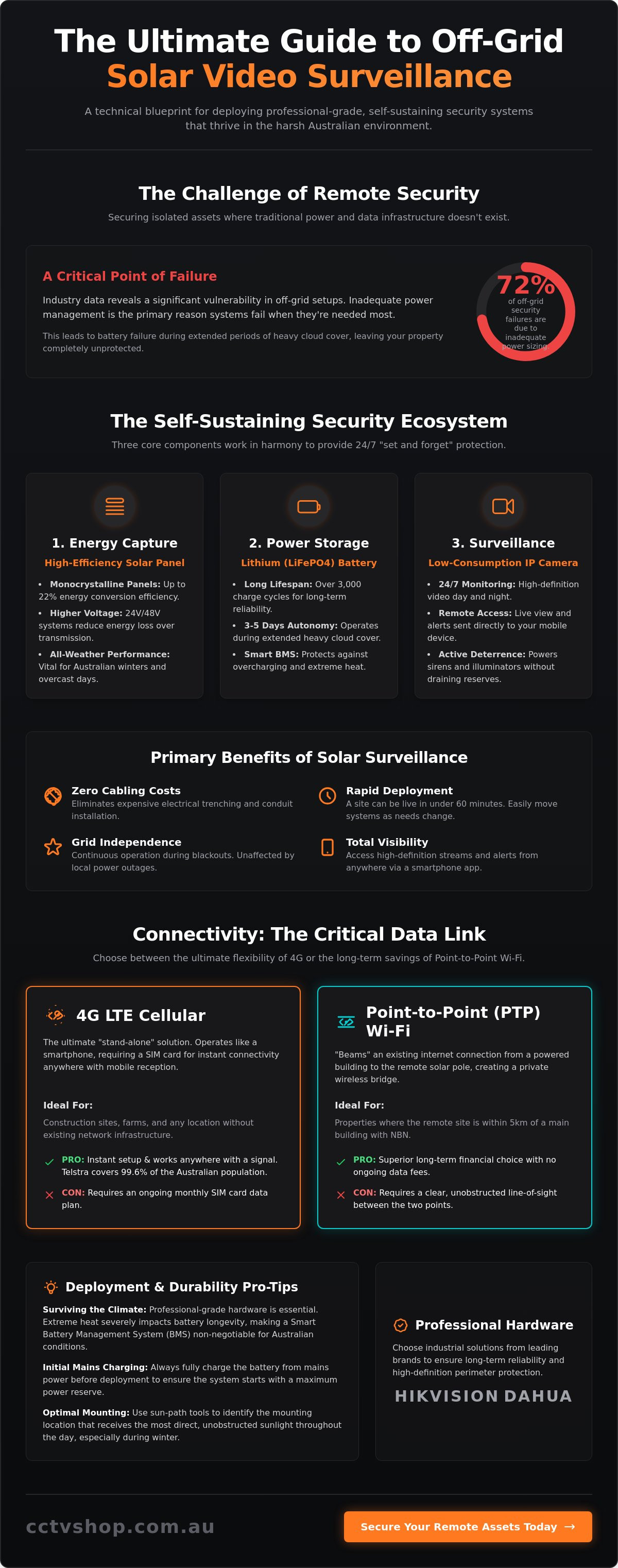
What if you could maintain 24/7 visibility on your most isolated assets without a single centimetre of copper cabling or a nearby power grid? You likely understand the frustration of trying to secure a rural property or a remote construction site where traditional infrastructure doesn't exist. It's stressful to worry about battery failure during three days of heavy cloud cover or to struggle with complex 4G data configurations. Industry data from 2024 shows that 72% of off-grid security failures are caused by inadequate power sizing, making a robust solar video surveillance system essential for true protection in the Australian outback.
This guide provides the technical blueprint to deploy professional-grade security that thrives in our harsh environment. You'll learn how to select hardware for a genuine "set and forget" experience and how to configure remote mobile access for real-time alerts. We'll break down the setup process from battery autonomy to 4G connectivity so you can achieve total visibility and peace of mind from any location.
Key Takeaways
- Understand the three core components required to build a self-sustaining security ecosystem that operates independently of the power grid.
- Discover how to maintain total visibility in remote areas by selecting the most reliable 4G LTE or long-range Wi-Fi connectivity for your solar video surveillance setup.
- Learn why professional-grade hardware is essential for surviving the harsh Australian climate and how extreme heat impacts battery longevity.
- Master the deployment process with technical insights on initial mains charging and using sun-path tools to identify the optimal mounting location.
- Compare industrial solutions from Hikvision and Dahua to ensure your off-grid installation provides long-term reliability and high-definition perimeter protection.
What is Solar Video Surveillance and How Does It Work?
Solar video surveillance is a self-sustaining security ecosystem designed to operate entirely independently of the traditional power grid. By 2026, advancements in energy harvesting and storage have transformed these systems from niche gadgets into high-performance professional tools. For Australian property owners, this technology provides a reliable solution for securing remote perimeters, construction sites, and rural assets where trenching cables is cost-prohibitive. Most Wireless security cameras in these professional kits rely on high-speed 4G or 5G networks to transmit data, ensuring total visibility without a single physical wire.
A professional solar video surveillance setup consists of three critical elements. First, a high-efficiency solar panel captures energy. Second, a lithium battery bank stores power for night-time use. Third, a low-consumption IP camera provides 24/7 monitoring. This combination ensures immunity to local power outages, which affected over 15% of regional Australian businesses in 2024. Deployment is rapid; a technician can often have a site live in under 60 minutes, providing immediate peace of mind.
The primary benefits of adopting this technology in 2026 include:
- Zero Cabling Costs: Eliminates the need for expensive electrical trenching and conduit installation.
- Rapid Deployment: Systems can be mounted on poles or temporary skids and moved as site requirements change.
- Grid Independence: Continuous operation during blackouts or in areas where mains power is unavailable.
- Total Visibility: High-definition streams are accessible via smartphone apps from any location with cellular coverage.
The Role of the Photovoltaic Panel
Modern systems utilize monocrystalline photovoltaic panels because they offer up to 22% energy conversion efficiency. This is vital during the shorter daylight hours of an Australian winter or in overcast conditions. While entry-level units often use 12V configurations, 2026 professional kits have transitioned to 24V or 48V systems. This higher voltage reduces energy loss during transmission. It allows the system to power high-draw features like active deterrence sirens and 100-metre infrared illuminators without exhausting the reservoir.
Battery Storage: The Power Reservoir
Lithium Iron Phosphate (LiFePO4) batteries are now the industry standard for 2026 surveillance installs. They offer over 3,000 charge cycles, which means they last significantly longer than older lead-acid alternatives. Reliability depends on "days of autonomy". This refers to how many days the system remains operational during heavy cloud cover. Professional-grade solar video surveillance kits typically provide 3 to 5 days of autonomy. An integrated Smart Battery Management System (BMS) protects the unit by preventing overcharging and managing thermal loads in the harsh Australian heat.
Connectivity Options: 4G LTE vs. Long-Range Wi-Fi
The most significant hurdle for off-grid security isn't generating power; it's the data link. A solar video surveillance system only provides true value if it can alert you to a breach in real time. Without a reliable way to get video to your phone, your hardware is simply a local recorder sitting in a paddock. You must choose between the flexibility of cellular networks or the long-term cost savings of a private wireless bridge.
4G Solar Security Cameras for Remote Sites
4G LTE cameras operate exactly like a smartphone. They require a standard Australian SIM card and a data plan from a provider like Telstra, Optus, or Vodafone. Telstra remains the preferred choice for many rural users because their 4G network covers 99.6% of the Australian population, reaching locations where other carriers fail. 4G cameras are the ultimate "stand-alone" solution for construction and farming. They allow for rapid deployment because they don't rely on any existing local network infrastructure.
- Pros: Instant setup; works anywhere with a mobile signal; no line-of-sight required to a main building.
- Cons: Ongoing monthly SIM card fees; dependent on carrier up-time.
Bridging the Gap with Long-Range Wireless
When your remote site is within 5km of a powered building with NBN, a Point-to-Point (PTP) wireless link is often the superior financial choice. By using professional networking gear from brands like Ubiquiti, you can "beam" your internet connection across open space to your solar pole. This setup creates a local network extension, meaning you pay $0 in ongoing monthly data fees. It's a robust way to integrate remote cameras into a larger security ecosystem. You can learn more about how these configurations work by reading our guide on CCTV Systems Explained.
Data Management and Avoiding Bill Shock
High-resolution video can be a data hog. A single 4K camera streaming at high bitrates can consume over 2GB of data in just one hour of active viewing. To manage this, we recommend using H.265+ compression, which reduces file sizes by up to 50% compared to older standards. Always set your mobile app to view the "sub-stream" (lower resolution) for quick checks, while leaving the "main-stream" (Ultra HD) to record locally to an SD card or NVR. This strategy ensures you have the evidence you need without blowing your monthly budget. If you're unsure which data path fits your site, contact our technical team for a tailored connectivity assessment.
Surviving the Australian Climate: Durability Standards
Australia's climate serves as a brutal testing ground for security electronics. Most "off-the-shelf" consumer cameras fail within 12 to 18 months because they aren't engineered for 45°C ambient temperatures. High-performance solar video surveillance requires industrial-grade components to maintain 24/7 uptime in our harsh conditions. When the sun beats down on a black camera casing, internal temperatures can exceed 70°C, causing standard processors to throttle or shut down entirely.
Heat is the primary killer of lithium batteries. A battery rated for 2,000 cycles at a steady 25°C might only achieve 800 cycles if it's consistently exposed to 40°C+ heatwaves. Professional systems mitigate this through intelligent charging algorithms that throttle current when temperatures spike, preserving the chemical integrity of the cells. Beyond heat, ingress protection is a critical factor for longevity. We consider IP67 the absolute minimum requirement for Australian conditions. This rating ensures the unit is dust-tight, which is vital for regional areas where fine bulldust can penetrate lesser IP65 seals. For coastal installations, salt-spray resistance is equally important. Standard aluminum alloys oxidize rapidly in salty air, so we recommend hardware with C4 or C5-M corrosion resistance ratings to protect your investment.
Heat Dissipation and Thermal Management
Professional Hikvision solar kits use specialized thermal housing designed to shed heat away from sensitive internal components. Without proper ventilation, batteries can swell or enter "thermal runaway" during peak summer months. It's vital to use mounting strategies that provide a 50mm air gap behind the solar panel. This natural airflow prevents heat soak into the camera bracket and ensures the system remains within its safe operating temperature range.
Wind Loading and Structural Integrity
A solar panel is essentially a sail. In a 100km/h wind gust, a 100W panel exerts hundreds of kilograms of lateral force on its mounting pole. DIY mounts often buckle or vibrate during storms, leading to shaky, unusable footage or total physical failure. Professional-grade junction boxes and reinforced steel brackets are necessary to maintain a stable image. Our team always recommends heavy-duty mounting hardware to ensure your solar video surveillance system stays pointed exactly where it needs to be, regardless of the weather.
Choosing the right hardware is about more than just specs; it's about long-term reliability. We focus on providing Australian stock that's proven to handle local conditions. If you're unsure about the durability requirements for your specific site, reach out for expert advice from our technical team.
How to Install Your Solar Security System: A Step-by-Step Guide
A successful installation begins 24 hours before you head outside. You must charge the system's internal battery via mains power using the provided DC adapter. This initial top-up ensures the lithium cells reach 100% capacity before the solar regulator takes over. Skipping this step can lead to early-cycle depletion, which often triggers "low battery" faults during the first night of operation.
Once the battery is primed, perform a site survey. We recommend using a sun-path app like Sun Seeker to identify the perfect mounting spot. You need to account for the sun's lower arc during the winter solstice in June. A location that receives full sun in December might be completely shaded by a neighbouring fence or building in mid-winter. After identifying the spot, attach the mounting bracket to a stable pole or wall. Secure the panel, camera, and battery enclosure according to the manufacturer's torque specifications to prevent vibration during high winds.
Configuration happens through the mobile app. Once the camera is powered on, scan the QR code to link it to your network. Set up your remote viewing and PIR motion alerts immediately. Finally, verify the "charging" status in the app while the panel is in direct sunlight. If the app shows a discharging status during the day, check your cable connections for a secure fit.
Optimal Panel Positioning for the Southern Hemisphere
For Australian installations, your solar panel must face North to achieve maximum solar gain. Facing South in the Southern Hemisphere will result in a 60% drop in energy harvest during the winter months. Set your tilt angle to your local latitude plus 15 degrees. This steeper angle captures the low-hanging winter sun more effectively and helps rainwater wash away dust. Clear all overhanging foliage that might cast micro-shadows, as even a small leaf shadow can reduce a panel's output by 30%.
Configuring Smart Detection to Save Power
Effective solar video surveillance relies on intelligent energy management. Use AcuSense or AI-powered human and vehicle detection to reduce false triggers from wind-blown trees or animals. This ensures the camera only records events that matter. PIR (Passive Infrared) sensors keep the camera in a "sleep mode" until heat-based motion is detected, which preserves the battery for nighttime use. If you face a week of heavy overcast weather, use the app to set the system to "low power" mode, which reduces the bitrate to maintain essential security functions.
If you need assistance selecting the right hardware for your specific site conditions, our team provides expert advice on all Australian-certified equipment.
Get expert advice from CCTV ShopChoosing Professional Hardware: Hikvision and Dahua Solutions
Selecting the right hardware is the difference between a system that fails during a storm and one that provides 24/7 reliability. While "pro-sumer" kits often suffice for basic residential needs, industrial solar video surveillance requires components built for the harsh Australian climate. Professional systems from Hikvision and Dahua use high-efficiency monocrystalline panels and lithium iron phosphate (LiFePO4) batteries. These batteries are rated for over 2,000 charge cycles, ensuring the system remains operational even after years of exposure to 40°C heat and intense UV radiation.
Reliability in remote locations depends on more than just a battery. It requires a "solution-first" approach where the camera, solar controller, and 4G transmission work in perfect harmony. Investing in professional-grade gear prevents the high costs associated with "truck rolls" to remote sites to fix equipment failures. By choosing established brands, you gain access to firmware updates that patch security vulnerabilities and improve AI accuracy over time.
Hikvision Solar-Powered 4G Kits
The Hikvision DS-2XS series is a benchmark for standalone monitoring. These integrated units are designed for rapid deployment in areas where running cables is impossible. A major advantage of these kits is the inclusion of ColorVu technology. Unlike standard cameras that switch to black and white at night, ColorVu provides full-color imagery in near-total darkness. This detail is vital for identifying the color of a vehicle or a person’s clothing during an incident. For a deeper look at their full range of capabilities, read The Ultimate Guide to Hikvision Security Systems.
Data integrity is another core strength of the Hikvision ecosystem. These cameras feature internal eMMC storage which acts as a fail-safe. If the 4G network connection drops due to tower maintenance or signal interference, the camera continues to record internally. Once the connection is restored, the footage automatically syncs to the cloud or your central management software, ensuring no gaps in your security timeline.
Dahua Off-Grid Surveillance
Dahua’s approach to solar video surveillance focuses on edge intelligence and bandwidth efficiency. Their WizSense solar kits use advanced AI to distinguish between humans, vehicles, and environmental noise like moving branches or animals. This precision reduces false alarms by up to 95%, which is critical for remote sites where every 4G data packet incurs a cost. You can learn more about these intelligent features in our Dahua Security Systems guide.
Efficiency is also reflected in Dahua’s use of H.265+ compression technology. This codec reduces storage requirements and bandwidth consumption by up to 70% compared to older standards. This allows for smoother remote viewing even in areas with low signal strength. Key benefits include:
- Centralized Management: Seamless integration with Dahua NVRs allows you to monitor multiple remote perimeters from a single dashboard.
- Smart Power Management: The system automatically adjusts its power consumption based on battery levels to ensure the camera stays online during extended periods of cloud cover.
- Durable Construction: IP67-rated housings protect sensitive electronics from dust and heavy rain.
Securing a remote asset requires more than just hardware; it requires a partnership with a trusted specialist. Opting for local Australian stock ensures that your equipment is fully compatible with local 4G and 5G frequency bands. Local technical support provides a layer of professional consultation that helps you troubleshoot configuration issues quickly. This commitment to local service ensures your investment delivers long-term ROI and the peace of mind that comes with total visibility.
Future-Proof Your Remote Site Security
Securing remote assets no longer requires expensive trenching or grid power. By integrating high-performance solar video surveillance with 4G LTE connectivity, you gain total visibility over construction sites, rural properties, or remote infrastructure. Choosing professional-grade hardware from Hikvision or Dahua ensures your system survives the harsh Australian sun and dust, meeting rigorous IP67 durability standards. We're an authorised Australian retailer providing local technical support and free DIY installation guides to help you get started without the stress. Every order includes flat-rate shipping nationwide across Australia, ensuring your equipment arrives safely and affordably. It's time to take control of your site's safety with a system that works as hard as you do. Expert advice is always available to ensure you select the right configuration for your specific environment.
Browse our range of professional Solar Powered Security Cameras
Start building your off-grid security solution today and enjoy the peace of mind that comes with professional-grade protection.
Frequently Asked Questions
Do solar security cameras work at night?
Yes, solar security cameras operate continuously at night by drawing power from high-capacity lithium batteries charged during daylight hours. Most professional-grade units feature infrared LEDs for 30-metre black and white visibility or integrated LED spotlights for 24/7 full-colour imaging. These systems are designed to store enough energy to power the camera through 14 hours of darkness without any interruption to your security coverage.
How much data does a 4G solar camera use per month?
A 4G solar camera typically consumes between 2GB and 5GB of data per month for standard motion-activated recording. If you perform frequent live streaming in ultra-high definition, usage can exceed 10GB monthly. We recommend an Australian prepaid data plan with at least 15GB to ensure consistent connectivity for your solar video surveillance system without the risk of data throttling or unexpected connection drops.
Can I install a solar security camera under a porch or in the shade?
You shouldn't install the solar panel in permanent shade because it requires direct UV exposure to maintain a positive charge balance. If your camera must be under a porch, use a model with a detachable solar panel and a 3-metre or 5-metre extension cable. This allows the camera to remain protected while the panel sits on the roof or a nearby pole to capture maximum Australian sunlight.
What happens to the camera if it rains for a week straight?
Professional solar cameras are engineered with a 3-day to 5-day power reserve to handle periods of heavy cloud or rain. Even during overcast weather, solar panels still harvest roughly 10% to 25% of their typical energy output. As long as the battery was fully charged before the storm, the system will continue to record and send alerts throughout the week without failing.
Is it easy to steal a solar-powered security camera?
It's difficult to steal these units when they're installed at the recommended height of 2.5 to 4 metres. Most systems include tamper-resistant mounting hardware and instant motion alerts that notify your phone the moment someone approaches the device. Even if a thief succeeds, the footage is already uploaded to the cloud or stored on an internal SD card that's hard to access quickly in the field.
Do I need a special SIM card for a 4G solar camera?
You don't need a special SIM, but you must use a standard Nano or Micro SIM card from a provider like Telstra, Optus, or Vodafone with an active data plan. It's vital to choose a provider with strong 4G or 5G coverage in your specific rural or urban location. Ensure the SIM is a data-only or mobile broadband plan rather than a restricted wearable or IoT-only SIM for the best performance.
How long do the batteries in solar cameras typically last?
The internal lithium-ion batteries in professional solar cameras typically last between 3 and 5 years before their charging capacity begins to diminish. These batteries are rated for approximately 500 to 1,000 full charge cycles. To maximize longevity, our local technical support team suggests positioning the panel to ensure the battery reaches a 100% charge state at least three times per week during winter months.
Can I view multiple solar cameras in one app?
Yes, you can manage and view up to 16 or 32 individual cameras through a single smartphone application. Modern security interfaces allow for a split-screen Multi-View mode, giving you total visibility across several remote sites simultaneously. This feature is essential for property owners monitoring multiple gates, sheds, or perimeter fences from one central dashboard on their mobile device, providing a seamless solar video surveillance experience.