


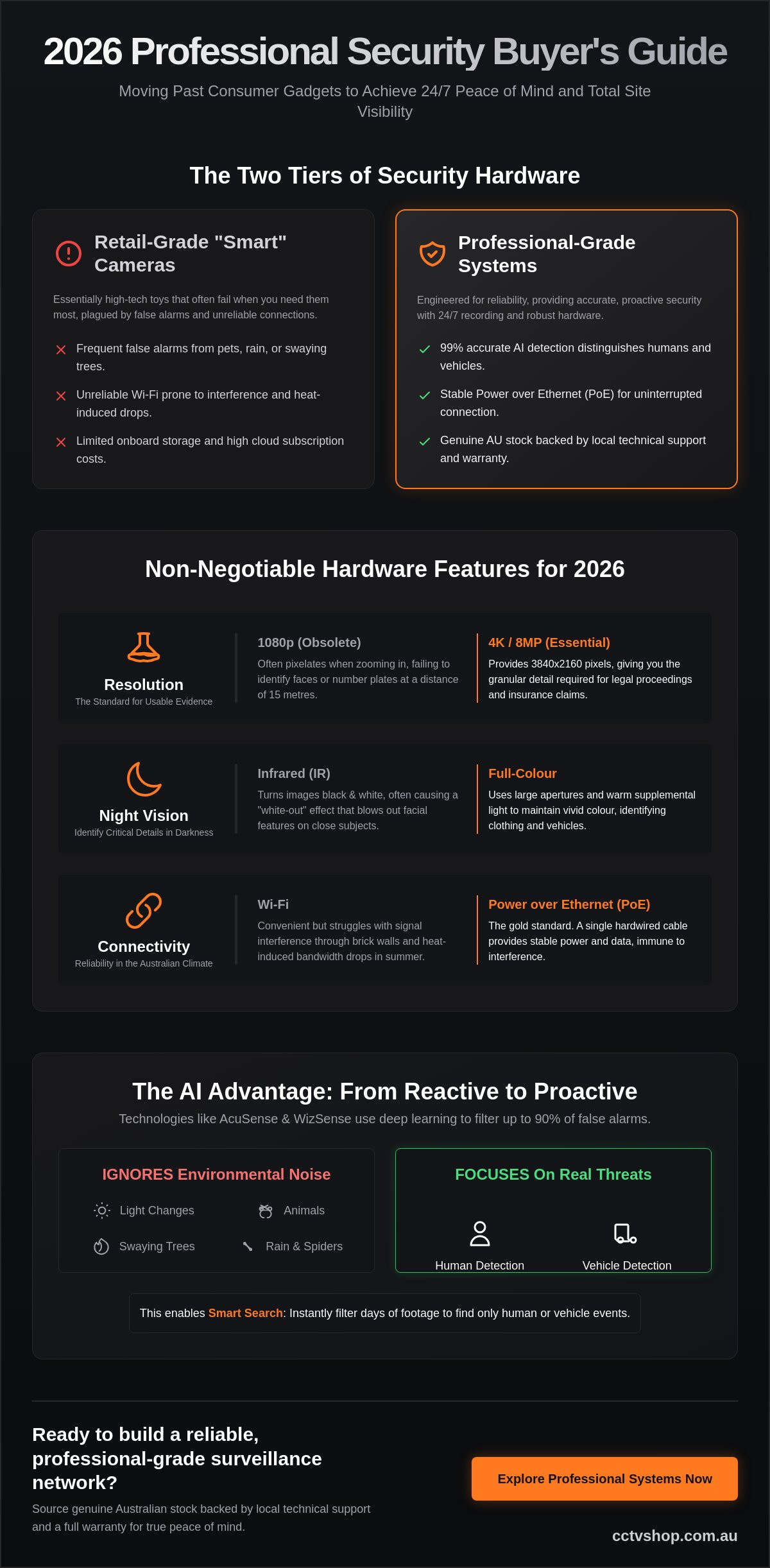
A retail-grade "smart camera" from a big-box store is essentially a high-tech toy that often fails exactly when you need it most. You likely understand that professional security requires more than just a basic Wi-Fi connection and a plastic mount. It's frustrating to invest in hardware only to be plagued by false alarms triggered by a stray pet or a heavy rainstorm. You need a system that accurately distinguishes between a genuine threat and the environment, ensuring you only receive alerts that actually matter.
This 2026 buyer's guide provides the technical clarity you need to build a reliable, professional-grade surveillance network for your property. We'll show you how to choose between industry leaders like Hikvision and Dahua while identifying which AI features provide real-world value. You'll learn the exact storage requirements for high-definition footage and how to ensure your Australian stock is backed by local technical support. We're moving past the confusion of consumer gadgets to provide a clear, data-backed framework for 24/7 peace of mind and total site visibility.
Key Takeaways
- Understand why physical security remains your most effective line of defence and how visual deterrence proactively protects Australian homes and businesses.
- Identify the essential hardware specifications for 2026, including why 4K resolution and full-colour night vision are critical for capturing usable evidence.
- Compare the technical capabilities of industry leaders like Hikvision and Dahua to determine which professional-grade system suits your specific site requirements.
- Learn how to implement a tiered surveillance strategy that balances wide-angle perimeter monitoring with high-detail focal points for entry protection.
- Discover the top-rated hardware picks for the year and how to source genuine Australian stock backed by local technical support.
Defining Physical Security: Why CCTV is Your First Line of Defence
While digital threats dominate headlines, protecting your physical assets remains the foundation of any risk management strategy. Understanding What is Physical Security? involves more than just locking doors; it requires a layered approach that integrates technology with physical barriers. Unlike cybersecurity, which guards data, physical security focuses on the safety of people and property. In Australia, visual deterrence is a powerful tool. A 2023 report by the Australian Institute of Criminology suggests that visible surveillance can reduce property crime by up to 13% in residential areas. Professional-grade hardware, such as 4K IP cameras, provides a level of reliability that consumer "smart home" gadgets can't match. These entry-level devices often suffer from latency and limited storage, whereas professional systems offer 24/7 recording and robust perimeter protection. Integrating these cameras with intercoms and alarms creates a unified shield for your premises.
The Shift from Reactive to Proactive Surveillance
By 2026, the industry has moved beyond simply recording events for later review. Modern systems use AI-driven analytics to identify potential threats before a breach occurs. Real-time alerts sent to your smartphone or NVR allow for immediate intervention, preventing loss rather than just documenting it. Active Deterrence is a combination of light, sound, and AI designed to warn off intruders before they gain entry. This proactive stance ensures your security system works as a preventative measure. It's about stopping the crime in progress, not just watching the footage the next morning. High-end sensors can now distinguish between a stray animal and a human intruder with 99% accuracy, reducing false alarms that plague older systems.
Commercial vs. Residential Security Needs
Business owners require scalable solutions that cover expansive perimeters and multi-site locations. For Australian property owners, compliance with the Privacy Act 1988 is essential to ensure cameras don't infringe on public spaces or neighbours' privacy. High-risk zones, such as loading docks or cash-handling areas, need targeted monitoring with high-resolution sensors. Residential users often focus on entry points and driveways, but the hardware should still be Australian stock to ensure local technical support and warranty coverage. Identifying these specific zones allows for a more efficient deployment of resources. Choosing professional gear ensures that your security investment provides long-term value through durability and superior night vision capabilities.
Key Features to Compare When Buying Security Hardware
Selecting hardware involves balancing technical specifications with real-world application. In 2026, 4K resolution (8MP) has become the non-negotiable standard for professional evidence. A 1080p image often pixelates when you zoom in to identify a face or a number plate at 15 metres. 4K provides 3840 x 2160 pixels, giving you the granular detail required for legal proceedings and insurance claims. Understanding these hardware choices starts with a solid foundation in an Introduction to Physical Security, which outlines how hardware acts as a primary countermeasure against risk.
Don't settle for basic infrared (IR) if you need colour at night. Traditional IR turns images black and white, often blowing out facial features with "white-out" effects when a subject gets too close. Full-colour night vision uses large apertures and warm supplemental lighting to maintain vivid colour in near-total darkness. This allows you to identify the colour of a getaway vehicle or a person's clothing, which is often the most critical piece of security intelligence for local authorities.
In the Australian climate, Power over Ethernet (PoE) remains the gold standard for reliability. While wireless cameras offer convenience, they often struggle with signal interference through thick brick or limestone walls. They also can't always handle the heat-induced bandwidth drops common in 40-degree summers. PoE uses a single cable for both power and data, ensuring a stable, hardwired connection that won't drop out when you need it most.
Understanding Intelligent Detection (AcuSense & WizSense)
Modern systems use deep learning to distinguish between actual threats and environmental noise. Technologies like AcuSense and WizSense filter out up to 90% of false alarms caused by heavy rain, swaying trees, or spiders crawling across the lens. This intelligence enables 'Smart Search,' where you can filter days of footage to find only 'human' or 'vehicle' events in seconds. High-end AI-enabled security cameras for home use are now affordable, bringing enterprise-grade logic to residential driveways across Australia.
Storage and Bandwidth Management
High-resolution footage demands efficient storage. H.265+ compression reduces file sizes by up to 80% compared to older H.264 codecs without degrading the 8MP image quality. For data redundancy, a Network Video Recorder (NVR) is superior to Edge Storage (SD cards). SD cards have finite read/write cycles and can fail in high-heat environments; an NVR provides centralized, multi-terabyte recording. To store 30 days of 24/7 footage from four 4K cameras, you'll typically need at least an 8TB surveillance-grade hard drive. If you're ready to upgrade your protection, explore our range of professional hardware designed for Australian conditions.
The Big Three: Comparing Hikvision, Dahua, and Reolink
Selecting a security system requires choosing a brand that offers longevity. Hikvision, Dahua, and Reolink represent the premier tier of global surveillance. These manufacturers invest billions in research and development, ensuring your hardware remains secure with regular firmware updates for five to seven years. Choosing a "Tier 1" brand means you aren't just buying a camera; you're investing in a maintained ecosystem that protects against emerging cyber threats while ensuring app compatibility with future smartphone updates.
Is Hikvision Right for Your Security Goals?
The Hikvision ecosystem is vast, featuring over 2,000 distinct camera models designed for every possible scenario. It's the industry leader for deep technical integration, making it the preferred choice for complex commercial setups. For Australian homeowners with basic requirements, the HiLook range provides a budget-friendly entry point without sacrificing the core Hik-Connect mobile experience. Hik-Connect remains a benchmark for remote viewing, offering low-latency streaming and reliable push notifications across Australian 4G and 5G networks.
The Dahua Advantage: AI and Innovation
Dahua focuses on AI-driven efficiency to solve real-world problems. Their WizSense technology uses deep learning to distinguish between humans and vehicles, which reduces false alarms by up to 95% in typical suburban environments. Their TiOC (Three-in-One Camera) units are particularly popular for active deterrence. These cameras combine full-color night vision, siren alerts, and flashing lights to stop intruders before they reach your door. Dahua's Full-color technology often outperforms competitors by maintaining vivid color images in lighting conditions as low as 0.0005 lux. You can explore these professional tools in our curated security collection for the latest hardware.
Reolink: The Leader in Wireless Flexibility
Reolink has carved out a specific niche for high-quality, user-friendly wireless and solar solutions. They're the ideal choice for Australian properties where running data cables through double-brick walls or high ceilings is difficult. Their 4K solar-powered cameras offer a plug-and-play experience that balances affordability with high resolution. While they don't offer the same deep backend integration as Hikvision, their standalone performance for DIY installers is unmatched in the 2026 market.
- Hikvision: Best for massive product variety and technical depth.
- Dahua: Best for AI-powered perimeter protection and night vision.
- Reolink: Best for solar-powered, wire-free installations.
- Tier 1 Support: All three brands offer local Australian stock and technical support through authorized partners.
By sticking to these established brands, you ensure your security investment remains functional and supported for years to come. We prioritize these manufacturers because they provide the technical reliability our customers expect, backed by local Australian warranties and expert advice.
Designing Your System: A Tiered Security Strategy
Building a robust security system requires a layered approach rather than a "one-size-fits-all" camera placement. By segmenting your property into four distinct tiers, you create a redundant environment where each component serves a specific tactical purpose. This strategy ensures that if one layer is bypassed, others remain active to capture the event.
- Tier 1: Perimeter Monitoring. Deploy wide-angle turret or bullet cameras to monitor fence lines, driveways, and street frontages. These act as your early warning system, detecting movement before a visitor reaches the building.
- Tier 2: Entry Point Protection. Install high-resolution 4K focal points or video doorbells at every door and accessible window. This tier focuses on capturing clear facial features and vocal interactions.
- Tier 3: Internal Security. Monitor high-value assets such as server racks, home safes, or inventory stockrooms using discreet dome cameras that blend into the ceiling.
- Tier 4: Management and Redundancy. Configure your Network Video Recorder (NVR) with high-capacity surveillance drives and enable encrypted cloud backups. This ensures your footage exists in two places simultaneously.
Camera Placement and Field of View
Effective surveillance fails when cameras are mounted too high. Positioning a camera four metres up often results in capturing only the tops of heads, which isn't useful for identification. Aim for a mounting height of 2.5 to 3 metres. Avoid facing lenses directly toward the North to prevent the harsh Australian sun from blowing out the image sensor. Use the Identify, Recognize, Detect (IRD) principle for lens selection. A 2.8mm lens is perfect for wide detection, while a 6mm or 12mm lens is required for specific identification zones. For large Australian acreages, a PTZ (Pan-Tilt-Zoom) camera provides the flexibility to track movement across vast distances without losing clarity.
Cabling and Infrastructure Basics
Reliable systems live and die by their cabling. Cat6 copper cable is the industry benchmark for PoE (Power over Ethernet) systems, providing the 10Gbps bandwidth potential necessary for 4K and 8K streams. Always protect your terminations with IP66-rated junction boxes and waterproof grommets to prevent corrosion in humid coastal climates. If you're expanding a network, a dedicated PoE switch allows you to run a single uplink to your NVR, simplifying the installation process while maintaining high data throughput. This professional infrastructure ensures your security hardware remains online when you need it most.
Ready to secure your property with professional-grade hardware? Explore our range of Australian-certified security solutions today.
Standout Security Solutions: Top Picks for 2026
The Hikvision 8MP AcuSense Turret Camera is the benchmark for performance in 2026. It utilizes deep learning algorithms to distinguish between humans, vehicles, and environmental noise. This technology reduces false alarm rates by 90 percent, ensuring you only receive alerts that matter. The 4K resolution provides the level of detail necessary for facial recognition and license plate identification at distances up to 30 meters.
For environments with zero ambient light, the Dahua Full-Colour 2.0 with Dual Light AI is the superior choice. It provides 24/7 color imagery by using a large F1.0 aperture lens. When the AI detects a target, it triggers warm white LEDs to capture critical forensic details that standard infrared systems miss. This makes it an essential tool for identifying clothing colors or vehicle shades in total darkness.
Remote Australian properties require the Reolink 4K Solar Powered Security Camera. It operates on a 2.4/5GHz dual-band Wi-Fi connection and draws power from a high-efficiency solar panel. The 4K resolution provides crisp evidence without needing a mains power source. It's an ideal solution for construction sites, rural gates, or storage sheds where cabling is impractical.
Small businesses benefit most from Hikvision 16-Channel NVR Bundled Kits. These systems offer a plug-and-play architecture that simplifies the installation process. They provide a centralized management hub for up to 16 cameras, making them ideal for growing retail spaces or warehouses that need comprehensive coverage and reliable local storage.
Why Buy from an Australian Security Specialist?
Selecting hardware from a local specialist ensures you receive genuine Australian stock. Grey market imports often lack local firmware updates and don't comply with Australian telecommunications standards. When you buy locally, you gain access to expert technical support for DIY troubleshooting. Most importantly, your equipment is backed by a full manufacturer's warranty, protecting your investment for the long term.
Final Checklist Before Your Purchase
- Confirm your camera is compatible with your NVR protocol, such as ONVIF or the manufacturer's private protocol.
- Verify your storage drive type. You must use surveillance-rated drives like WD Purple or Seagate SkyHawk. These are designed for 24/7 write cycles, unlike standard PC hard drives which fail under constant use.
- Check your internet upload speed to ensure it can handle 4K remote streaming.
- Ensure you have the correct mounting brackets for your specific wall or ceiling material.
Ready to secure your property? Browse the full Security collection at CCTV Shop.
Future-Proof Your Property Protection for 2026
Navigating the 2026 surveillance landscape requires a clear understanding of hardware benchmarks and ecosystem compatibility. You've seen how a tiered protection strategy ensures no blind spots, while the direct comparison between industry leaders Hikvision, Dahua, and Reolink highlights the necessity of choosing authorized hardware for long-term reliability. Implementing ultra-high definition sensors and perimeter monitoring isn't just about recording events; it's about active prevention that scales with your needs. Choosing the right components today prevents technical debt and operational gaps in the years ahead.
As an Australian owned and operated specialist, CCTV Shop provides the technical depth needed to protect your home or business. We're an authorized partner for Hikvision and Dahua, ensuring every unit is genuine local stock that meets Australian regulatory standards. Our team provides expert technical support to help you configure a seamless surveillance system that delivers total visibility and peace of mind. Whether you're a DIY homeowner or a professional installer, the right hardware makes the difference between a simple camera and a comprehensive protection network.
Take the next step in safeguarding your premises with professional-grade solutions backed by local expertise. Shop the 2026 Security Collection at CCTV Shop and build a system you can rely on for years to come.
Frequently Asked Questions
Is it legal to install my own security cameras in Australia?
You can legally install your own security cameras on residential property in Australia, provided you don't infringe on the privacy of others. Under the Surveillance Devices Act 1999 and similar state-based legislation, it's an offence to record private activities without consent. Ensure your cameras are positioned to monitor your own land and avoid capturing a neighbour's windows or backyard to remain compliant with Australian privacy principles.
What is the difference between an IP camera and an analog camera?
IP cameras transmit digital video signals over a network cable, while analog cameras use coaxial cables to send raw signals to a recorder. Modern IP systems offer resolutions up to 12MP and include advanced features like Power over Ethernet (PoE) for simpler installation. Analog systems are generally more affordable, but they lack the scalability and high-definition clarity required for professional security applications in 2026.
How much storage do I need for four 4K security cameras?
Four 4K cameras recording at 15 frames per second using H.265 compression require roughly 6TB of storage for a 30-day archive. If you configure the system for motion-triggered recording instead of continuous capture, this requirement often drops by 40 percent. We recommend using dedicated surveillance drives like Western Digital Purple, as they're engineered to handle the constant write-cycles of a 24/7 security system without failing.
Can I view my security cameras on my phone while I'm away?
You can view your cameras on your phone from anywhere in the world using a secure mobile app and a stable internet connection. Most professional systems use P2P technology to establish a direct link between your recorder and smartphone without complex network configuration. This allows for real-time alerts, live viewing, and playback of recorded events over any standard 4G, 5G, or Wi-Fi network.
Do I need a subscription to use professional security cameras?
Professional systems with a dedicated Network Video Recorder (NVR) don't require a monthly subscription to function. Unlike consumer cloud-based brands, these systems store all footage locally on internal hard drives. This approach eliminates ongoing fees and ensures your data remains under your total control. While some brands offer optional paid cloud backups, the core features and remote access remain free for the life of the hardware.
What happens to my security system during a power outage?
Your security system will stop recording during a power outage unless it's connected to an Uninterruptible Power Supply (UPS). A standard 1500VA UPS typically keeps a four-camera NVR system running for 20 to 40 minutes. For extended protection, we recommend integrating your surveillance hardware with a dedicated battery backup or a solar-powered circuit to maintain visibility when the grid fails.
How long do professional security cameras typically last?
Professional-grade security cameras typically have a functional lifespan of 5 to 8 years when maintained correctly. Harsh Australian conditions like high UV levels and salt spray in coastal areas can impact longevity, so look for units with an IP67 weather-resistance rating. While the hardware may continue to operate beyond this period, many users choose to upgrade after 60 months to access newer AI-driven detection features.
Is a wireless security camera as reliable as a wired PoE camera?
Wired PoE cameras are more reliable than wireless alternatives because they eliminate the risk of signal interference and bandwidth dropouts. A single Cat6 cable provides both power and data for distances up to 100 metres without any loss in performance. Wireless cameras often suffer from latency issues and require individual power points, making them less suitable for high-stakes environments where constant uptime is a priority.