


Your security system shouldn't treat a stray cat or a heavy downpour with the same urgency as a person climbing your fence. If you've ever been woken at 3:00 AM by a false alarm caused by a wind-blown branch, you know that excessive notifications lead to alert fatigue. You likely invested in surveillance for peace of mind, but the reality of managing constant, meaningless pings can feel like a second job.
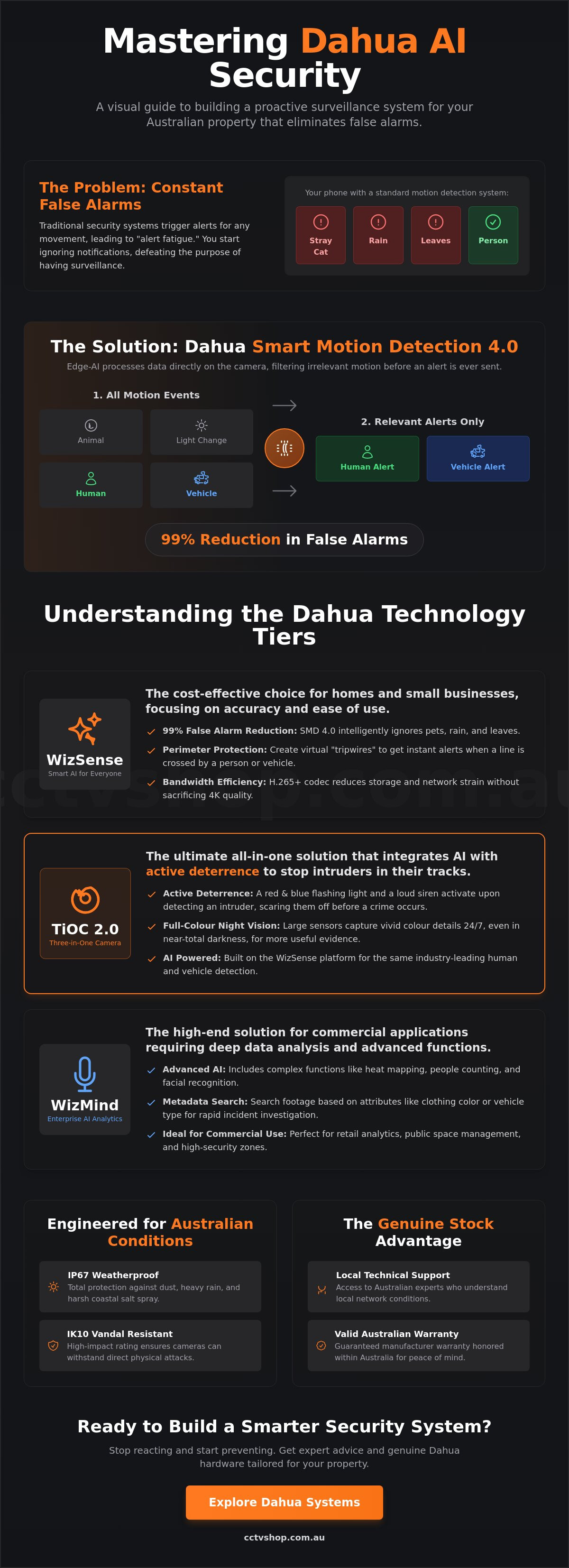
This guide simplifies the technical jargon to help you master dahua security cameras, ensuring your Australian property is protected by SMD 4.0 technology that reduces false alarms by 99% according to Dahua's latest technical benchmarks. We'll show you how to build a system that only alerts you for real human or vehicle threats while maintaining professional-grade 4K footage day and night.
We'll break down the specific differences between WizSense and WizMind, explain how TiOC provides active deterrence, and provide a clear roadmap for selecting hardware that includes genuine local technical support for the Australian market.
Key Takeaways
- Identify the critical differences between WizSense, WizMind, and TiOC technologies to choose a system that delivers proactive AI deterrence rather than just passive recording.
- Learn how to match camera form factors like Turret and PTZ to your specific environmental conditions, ensuring IP67 weatherproofing and IK10 vandal resistance.
- Determine the exact NVR and storage requirements needed to build a scalable, high-performance brain for your surveillance network.
- Master the technical selection of dahua security cameras to achieve professional-grade human and vehicle detection tailored for Australian properties.
- Understand the vital importance of sourcing genuine Australian stock to guarantee local technical support, valid warranties, and critical firmware updates.
Why Dahua Security Cameras Lead the Australian Surveillance Market
Dahua Technology is a global powerhouse in IoT-centric smart video surveillance. According to the Dahua Technology company profile, the manufacturer has evolved from a specialist hardware firm into a massive international entity that defines modern security standards. In 2026, the Australian market has seen a decisive shift from reactive recording to proactive deterrence. It's no longer enough to have footage of an incident after it occurs. Today, dahua security cameras are designed to intervene before a crime is committed, using high-tier AI integration to identify and discourage intruders in real-time.
For Australian users, Dahua hardware addresses specific local challenges. The equipment is engineered to survive harsh climates, from the intense UV radiation of Queensland to the salt spray of coastal New South Wales. Beyond durability, these systems excel in low-light performance. Their sensors capture clear, full-colour details in environments where traditional cameras only show grainy black-and-white shadows. Dahua maintains a unique position by offering professional-grade hardware that remains accessible. They provide the technical depth required by commercial installers while ensuring the software is intuitive for the average homeowner.
- Proactive Deterrence: Built-in sirens and strobe lights trigger upon human detection.
- Environmental Resilience: High IP67 ratings ensure protection against dust and heavy rain.
- Superior Imaging: Large sensors allow for 24/7 colour monitoring even in near-total darkness.
The Core Philosophy: Intelligence at the Edge
Edge AI refers to the camera's ability to process data on its own internal chipset rather than relying solely on a central recorder. This localized processing is critical for managing high-resolution 4K and 8MP streams without causing network lag. By filtering out false alarms like falling leaves or animals directly at the source, Dahua systems reduce bandwidth strain by up to 50%. This ecosystem, comprised of smart cameras, high-performance NVRs, and the DMSS mobile app, ensures that your security alerts are both fast and accurate.
Dahua vs. Hikvision: A Solution-First Comparison
When comparing the industry's two giants, the choice often depends on your specific perimeter protection needs. While you can explore our comprehensive guide to Hikvision security systems, Dahua is frequently preferred for its Three-in-One Camera (TiOC) technology. This specific solution integrates AI, active deterrence, and full-colour monitoring into a single device. Dahua’s mobile app, DMSS, is often cited for its superior stability and faster remote wake-up times. If your goal is a streamlined user experience with aggressive perimeter defense, dahua security cameras offer a more integrated, "out-of-the-box" solution for the Australian residential and small business sectors.
Understanding the 2026 Dahua Range: WizSense, WizMind, and TiOC
Choosing the right dahua security cameras for your property requires a clear understanding of how the manufacturer categorizes its technology. Dahua organizes its 2026 catalog into three distinct tiers based on processing power and AI capabilities. This structure helps you avoid over-spending on enterprise features while ensuring your system has the intelligence required for your specific environment. Whether you're securing a suburban home in Perth or a commercial warehouse in Sydney, matching the hardware to the risk profile is essential for long-term value.
WizSense: Smarter Detection for Every Home
The WizSense series represents the most cost-effective entry point for professional-grade surveillance. It focuses on the features that matter most to homeowners and small business owners: accuracy and ease of use. At the core of this range is SMD 4.0 (Smart Motion Detection). This technology uses deep learning to distinguish between humans, vehicles, and irrelevant "noise" such as pets, heavy rain, or falling leaves.
- Reduced False Alarms: SMD 4.0 filters out up to 99 percent of non-target motion, ensuring your phone only buzzes for real threats.
- Perimeter Protection: This allows you to draw virtual tripwires around your property. If a human crosses the line, the system triggers an instant alert.
- Efficiency: WizSense cameras use advanced H.265+ compression, saving up to 70 percent on storage space compared to older models.
TiOC: The Power of Active Deterrence
TiOC stands for Three-in-One Camera. It's designed to stop a crime before it happens. While traditional dahua security cameras record evidence, TiOC models act as a digital security guard. They combine 24/7 full-colour night vision, AI-driven detection, and active alarm features into a single unit.
When an intruder enters a restricted zone, the camera activates high-intensity red and blue strobe lights and a customizable siren. This visual and auditory warning is often enough to make a trespasser flee immediately. You can also use the two-way audio feature via the smartphone app to speak directly to whoever is on your property. This makes TiOC an ideal solution for driveways, front gates, and vulnerable side access points. If you need help selecting the right model for your layout, our specialists provide expert advice on system design for Australian conditions.
WizMind: Enterprise Intelligence
WizMind is the high-end tier reserved for complex commercial applications. These cameras possess significantly higher processing power to handle advanced metadata. In 2026, WizMind hardware supports sophisticated face recognition, people counting for retail analytics, and heat mapping to track foot traffic patterns. For logistics hubs, WizMind offers ANPR (Automatic Number Plate Recognition) that can manage gate access for authorized vehicles automatically. It's a solution-first range built for users who need data-backed insights alongside high-definition video.
Choosing the Right Camera Style: Turret vs. Bullet vs. PTZ
Selecting the right housing for your dahua security cameras is a decision that dictates long-term performance. While high resolution is vital, the physical design determines how the lens interacts with its surroundings. High-quality 2026 models prioritize IP67 weatherproofing to handle intense Australian rain and IK10 vandal resistance for high-traffic areas. Choosing a camera that matches its specific mounting location ensures you don't face constant maintenance issues or obscured footage.
- IP67 Rating: Total protection against dust and immersion in water up to 1 metre.
- IK10 Rating: Protection against 20 joules of impact, equivalent to a 5kg weight dropped from 40cm.
- Form Factor: Influences how the camera handles light reflection and physical obstructions like spider webs.
Turret Cameras: The Australian Residential Standard
Turrets have become the preferred choice for Australian homes. Their flat-faced design is specifically engineered to prevent spiders from spinning webs across the lens. This is a significant advantage over dome cameras, which often suffer from "IR bounce back" where night vision reflects off the glass cover. Because they use a ball-and-socket joint, turrets are remarkably easy to adjust during a DIY installation. They're the ideal solution for under eaves, porches, and front entryways where a discreet but effective presence is needed.
PTZ and Bullet Cameras: When to Scale Up
Bullet cameras offer a clear visual deterrent. Their prominent profile makes them ideal for long driveways or commercial perimeters where you want potential intruders to see the surveillance. PTZ (Pan-Tilt-Zoom) cameras provide active tracking capabilities. These units move automatically to follow moving targets, providing detailed close-ups of faces or license plates across large areas. They're best used in high-vantage points where they can scan 360 degrees without obstruction.
Modern security setups often combine these different styles into a comprehensive home security camera system. You might use turrets for the house perimeter and a single PTZ for the backyard. We're also seeing a rapid shift toward Dual-Lens and Panoramic dahua security cameras. These units provide 180-degree coverage without the distortion of traditional fisheye lenses. This often reduces the total number of devices required to cover a single property, providing better value and simpler management.
Building Your System: NVRs, PoE, and Storage Requirements
The Network Video Recorder (NVR) acts as the central intelligence for your dahua security cameras system. It processes high-definition video feeds, manages complex AI analytics, and provides the interface for remote viewing via the DMSS app. Selecting the right NVR is a critical first step in ensuring long-term system stability and performance. We only supply Australian stock with local technical support to ensure your system remains secure and compliant with local standards.
- Step 1: Calculate Channel Requirements. Audit every entry point and blind spot before purchasing. A 4-channel NVR suits basic units, but most Australian homeowners opt for 8-channel units to allow for future expansion. For commercial sites, 16 or 32-channel models provide the necessary overhead for comprehensive perimeter coverage.
- Step 2: Leverage PoE (Power over Ethernet). Professional installations rely on PoE technology. This sends power and data over a single Cat6 cable, which simplifies the wiring process and reduces installation costs significantly. Dahua NVRs feature built-in PoE ports, making them a reliable plug-and-play solution for local DIYers and professional installers.
- Step 3: Size Your Storage. Reliable 24/7 recording requires specialized hardware. Standard desktop drives aren't designed for the heat and constant write-cycles of a surveillance system. You'll need high-capacity drives that can handle multiple 4K streams simultaneously without dropping frames.
Smart Dual Illuminators and Full-Color Technology
Dahua’s Full-color technology delivers 24/7 vivid detail by using high-performance sensors and large apertures. When paired with Smart Dual Illuminators, the system stays in discreet IR mode until the AI detects a human or vehicle. It then switches to white light to capture full-colour evidence. It's essential to verify that your NVR supports the latest AI metadata to categorize these events and allow for rapid footage retrieval.
Storage and Bandwidth Optimization
Managing data is easier with H.265+ compression. This intelligent codec reduces storage and bandwidth requirements by up to 70 percent compared to older H.264 standards. While motion-only recording saves space, most Australian security experts recommend 24/7 recording on surveillance-grade drives. We recommend Western Digital Purple or Seagate SkyHawk drives, as they're rated for 180TB per year workloads and 24/7 operation. This ensures your dahua security cameras never miss a second of critical footage due to drive failure.
Ready to configure your hardware? Browse our range of genuine Dahua NVRs and storage solutions.
Expert Support and National Distribution for Dahua
Selecting the right hardware is only the first step in securing your property. The performance of your dahua security cameras depends heavily on the quality of the supply chain and the technical support available during the configuration phase. In the Australian market, the distinction between a professional installation and a failed DIY project often comes down to where the stock was sourced and the level of post-purchase assistance provided.
CCTV Shop serves as a bridge between complex surveillance technology and practical, real-world application. We provide comprehensive technical support for DIY installers across Australia, ensuring that NVR settings, motion detection zones, and AI tripwire parameters are calibrated correctly from day one. Our specialists understand the local 2026 security landscape, where high-definition video must be balanced with efficient bandwidth management and secure remote access.
Genuine Australian Stock vs. Grey Market
The temptation to purchase "grey market" cameras from overseas platforms often leads to significant long-term costs. These units are frequently intended for different regional markets and contain modified firmware to display English menus. If you attempt to update the software to fix a bug or patch a security vulnerability, the camera will often "brick," becoming completely unusable. Local Dahua technicians cannot service these units, and they carry no valid Australian warranty.
Genuine Australian stock guarantees access to the latest official firmware updates and local hardware replacement programs. You can verify your hardware by checking for the Dahua Australia holographic sticker or by cross-referencing the serial number with local distribution databases. Buying local ensures your system remains compatible with the DMSS mobile app and receives the necessary security patches to protect your network from external threats.
Get Started with Your Dahua System Today
Building a robust surveillance network requires attention to detail. Before finalizing your order, review this essential checklist to ensure your 2026 hardware configuration meets your specific needs:
- PoE Budget: Ensure your NVR or switch provides enough wattage for all connected cameras, especially those with high-powered infrared or TiOC features.
- Storage Capacity: Calculate your HDD requirements based on 4K resolution and H.265+ compression to ensure at least 14 days of retained footage.
- Cable Quality: Use solid copper Cat6 cabling to prevent voltage drop and signal degradation over long distances.
- Firmware Sync: Confirm that your NVR and dahua security cameras are running compatible firmware versions for seamless AI integration.
For a deeper dive into specific hardware configurations and AI capabilities, read our Dahua Security Systems guide. This resource provides the technical foundation needed to master modern surveillance tools.
If you're ready to secure your home or business, our specialists are available to provide a custom-tailored quote that fits your layout and budget. Visit our online store to explore the latest 2026 Dahua models and take the first step toward total visibility and peace of mind.
Future-Proof Your Australian Property with Dahua Technology
Selecting the right surveillance setup requires a balance of advanced AI features and reliable hardware. By 2026, technologies like WizSense and TiOC have set a new benchmark for proactive protection, offering high-accuracy human and vehicle detection to minimize false alarms. Whether you're deploying a single turret camera for a home driveway or a multi-site WizMind system for a commercial warehouse, the technical choice impacts your long-term security outcomes.
We've simplified the process of sourcing dahua security cameras by providing a direct path to official Australian stock. You don't have to navigate complex configurations alone; our team provides free DIY installation support to ensure your PoE or NVR system is running optimally from day one. Every order ships nationwide from our Western Australia warehouse, ensuring your hardware arrives quickly and ready for deployment.
Ready to upgrade your surveillance? Shop the full range of Dahua Security Cameras and Kits at CCTV Shop today. Take control of your safety with expert-backed solutions designed for the Australian environment.
Frequently Asked Questions
Is Dahua better than Hikvision for home security?
Both brands dominate 40 percent of the global market, but Dahua often provides better value for Australian homeowners seeking user-friendly interfaces. Dahua's DMSS app is streamlined for remote access; it's generally more intuitive for daily use. While Hikvision offers vast hardware options, Dahua focuses on AI integration like WizSense at a competitive price point. We recommend Dahua for its seamless local support and reliable firmware updates.
Can I install Dahua security cameras myself?
You can install dahua security cameras as a DIY project if you're comfortable with basic networking, though Australian state regulations often require a licensed security technician for permanent cabling. Plug-and-play PoE systems simplify the process. You'll need to run a single Cat6 cable from the NVR to each camera. For a professional finish and valid insurance claims, a licensed installer ensures the system meets AS/NZS 2201 standards.
What is the difference between Dahua WizSense and WizMind?
WizSense focuses on cost-effective AI for human and vehicle detection, while WizMind is a high-end enterprise solution for complex data analytics. WizSense reduces false alarms by 98 percent in residential settings. WizMind adds advanced features like face recognition, heat mapping, and people counting. For 95 percent of Australian homes and small businesses, WizSense provides the necessary perimeter protection without the enterprise-level price tag.
Do Dahua cameras work with a third-party NVR?
Dahua cameras are compatible with third-party recorders that support the ONVIF protocol. Most modern NVRs use ONVIF Profile S for basic video streaming. However, using a Dahua NVR is recommended to access 100 percent of the camera's features. Third-party systems often lose advanced AI functions like Tripwire or SMD 4.0. Using matching hardware ensures your dahua security cameras perform with maximum technical reliability.
How much storage do I need for four 4K Dahua cameras?
A 4TB surveillance-grade hard drive provides approximately 10 to 14 days of continuous recording for four 4K cameras using H.265+ compression. Storage requirements depend on your bitrate and frame rate. If you switch to motion-activated recording, that same 4TB drive can last over 30 days. We always suggest Western Digital Purple or Seagate SkyHawk drives for 24/7 reliability in harsh Australian conditions.
Does Dahua have a monthly subscription fee for the app?
The Dahua DMSS app doesn't require a monthly subscription fee for standard remote viewing and alerts. You get full access to live feeds, playback, and push notifications for free. This saves you roughly A$100 to A$200 per year compared to cloud-based brands that charge per camera. Your data stays on your local NVR, ensuring better privacy and zero ongoing costs for the life of the system.
Are Dahua cameras waterproof enough for Australian storms?
Most Dahua outdoor cameras carry an IP67 rating, which means they're completely dust-tight and can withstand heavy rain and temporary immersion. This rating ensures protection against the 100mm per hour downpours common in Queensland or Sydney. The aluminium housings are built to handle 40 degree Celsius heat and high UV levels of the Australian summer. For coastal areas, we recommend choosing models with anti-corrosion coatings for long-term durability.