


What if the "smart" security camera you just installed is actually just an expensive notification machine for every spider that crawls across the lens? It's a common frustration for Australian homeowners who invest in off-the-shelf kits, only to find that rain or wind triggers constant false alarms while actual threats remain a blurry mess of pixels. You deserve a system that provides genuine peace of mind, not a digital headache that drops its Wi-Fi connection the moment you leave the house.
Finding the best home cctv system australia requires looking past the marketing hype and focusing on technical reliability. We've developed this 2026 professional selection checklist to help you secure a professional-grade surveillance system that actually protects your property. You'll learn how to achieve crystal clear 4K identification of faces and license plates, even in total darkness. This guide covers everything from avoiding high subscription fees for cloud storage to selecting hardware that survives a 45-degree Australian summer. We'll walk you through the essential components of a reliable NVR setup that offers 24/7 recording and total visibility without the compromise of consumer-grade Wi-Fi cameras.
Key Takeaways
- Learn why professional-grade PoE systems outperform consumer Wi-Fi cameras and how to assess your property’s cabling requirements for a reliable, long-term installation.
- Discover how to identify the best home cctv system australia has to offer by looking beyond megapixel marketing to prioritize high-performance sensor sizes for superior low-light clarity.
- Master the "three rings" of security strategy to optimize camera placement, ensuring a seamless balance between wide-area perimeter coverage and forensic facial recognition.
- Understand the technical hardware requirements for a stable setup, including the critical differences between NVR built-in ports and dedicated PoE switches for power management.
- Configure advanced remote viewing and push notifications for human and vehicle detection to ensure you receive real-time, actionable alerts directly to your mobile device.
Defining the Best Home CCTV System: Professional vs. Consumer Grade
Finding the best home cctv system australia requires a shift in perspective. Many homeowners start their search at department stores, drawn to colorful boxes of battery-powered Wi-Fi cameras. While these gadgets offer convenience, they often fail the reliability test during a real security event. Professional security focuses on 100% capture rates, not just occasional snapshots. Brands like Hikvision and Dahua currently account for over 80% of the professional Australian security market because they prioritize hardware longevity and high-resolution data throughput over marketing gimmicks.
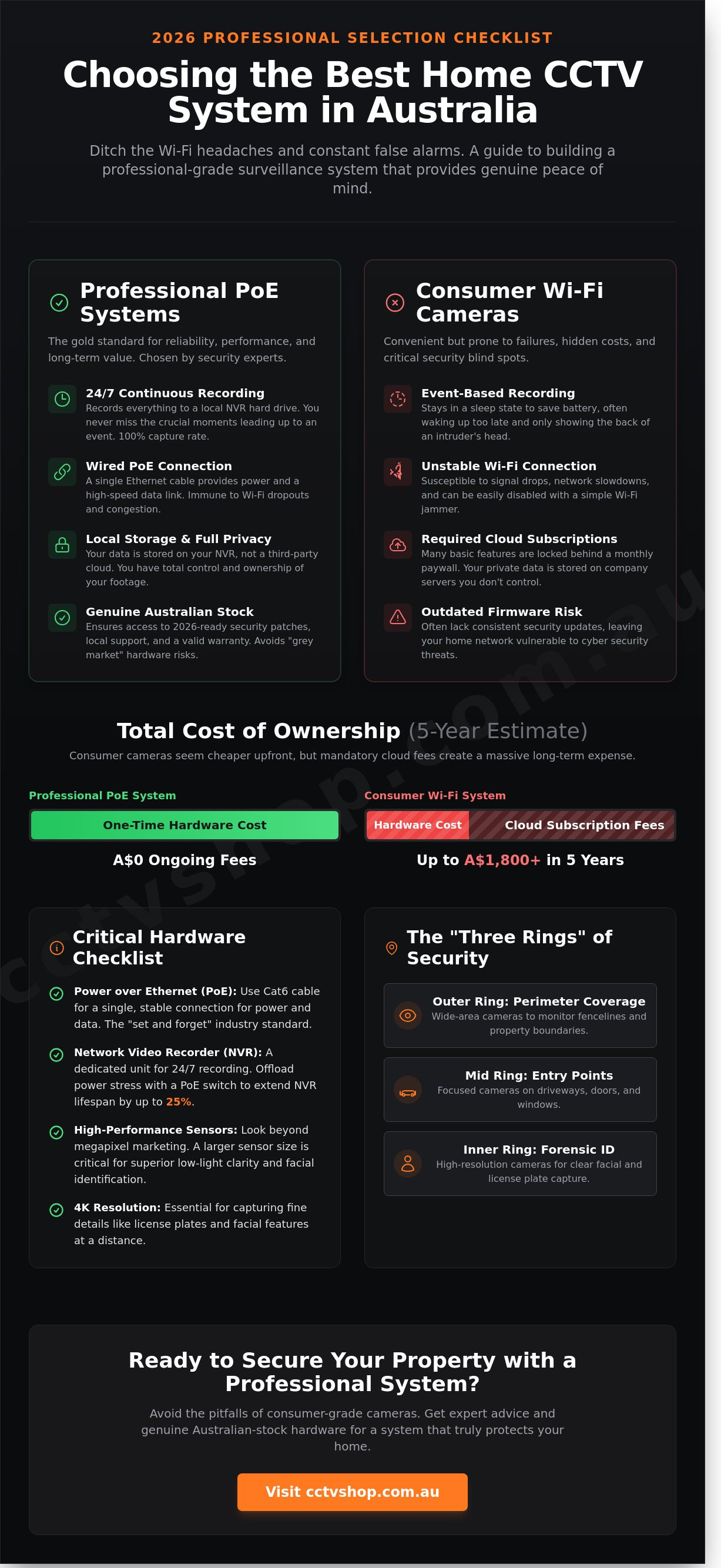
A fundamental part of understanding CCTV technology is recognizing the difference between "event-based" and "continuous" recording. Consumer Wi-Fi cameras stay in a sleep state to preserve battery, waking up only when they detect motion. This often results in a two-second delay, meaning you see the back of an intruder's head rather than their face. Professional systems record 24/7 to a local hard drive, ensuring you never miss the lead-up to an incident.
The total cost of ownership is another area where professional systems outperform consumer alternatives. Many "cheap" wireless brands require monthly cloud subscriptions to access basic features or more than 24 hours of footage. These fees often range from A$10 to A$30 per month. Over a five-year period, a homeowner might spend an additional A$1,800 just to keep their cameras functional. A professional system uses local storage with no ongoing fees, providing a better return on investment and total control over your private data.
PoE Systems: The Gold Standard for Home Security
Power over Ethernet (PoE) is the preferred choice for anyone seeking the best home cctv system australia can offer. This technology uses a single Cat6 cable to transmit both power and high-speed data. It eliminates the need for nearby power points and removes the instability of Wi-Fi signals. A dedicated Network Video Recorder (NVR) manages the traffic, ensuring that your home network isn't slowed down by constant video streaming. Professional installers choose PoE for permanent residences because it offers a "set and forget" level of reliability that battery units cannot match.
Why Local Australian Stock and Support Matter
The Australian security market is frequently targeted by "grey market" importers who sell hardware intended for other regions. These units often arrive with hacked firmware that cannot be updated. By 2026, cyber security protocols have become so stringent that running outdated firmware is a significant risk to your home network. Genuine Australian stock ensures you receive 2026-ready security patches and local technical support. If you're considering a high-performance setup, it's worth reading The Ultimate Guide to Hikvision Security Systems to understand how local warranty protection and official firmware keep your property safe long-term.
Pre-Purchase Infrastructure Checklist: Preparing Your Property
Building the best home cctv system australia requires more than just high-end cameras. It demands a robust physical infrastructure. Before purchasing hardware, you must assess your property's "bones." Start by inspecting your roof space and wall cavities. Most Australian homes built after 1990 feature brick veneer or weatherboard, which usually provides enough crawl space for cable runs. If you have a flat roof or limited access, you might need to consider external conduit or specialized slimline PoE (Power over Ethernet) cabling.
Power management is your next priority. You'll need to decide between using the built-in PoE ports on your Network Video Recorder (NVR) or an external PoE switch. A dedicated 8-port PoE switch offloads heat and power stress from the NVR, which can extend the lifespan of your recording unit by 25 percent. When planning your camera angles, remember to consult the Australian privacy laws for security cameras to ensure your perimeter protection doesn't infringe on a neighbour's right to privacy.
Remote viewing performance depends entirely on your NBN upload speed. For a four-camera 4K setup, you'll need a minimum consistent upload speed of 15 to 20 Mbps to view high-bitrate streams without lag. Finally, choose a secure, ventilated location for your NVR. Avoid high-traffic areas; instead, opt for a lockable data cabinet or a hidden, ventilated cupboard to prevent physical tampering or theft of the "brains" of your system.
The Wired Foundation: Cat6 Cabling
In 2026, Cat6 is the non-negotiable standard for professional installations. While Cat5e technically supports gigabit speeds, Cat6 provides the 250 MHz bandwidth necessary for 8K video transmission and reduces "crosstalk" interference. Always run your data cables at least 300mm away from electrical mains to prevent signal degradation. For external mounting points, use IP66-rated junction boxes. These protect your RJ45 connections from the harsh Australian sun and driving rain, preventing the corrosion that causes 80 percent of system failures in coastal areas. If you're unsure about cable paths, seeking expert advice during the planning phase can save hours of troubleshooting later.
Storage Strategy: Hard Drive and NVR Selection
Your storage needs are dictated by resolution and frame rate. A standard 4K camera recording at 20 frames per second consumes roughly 60GB of data every 24 hours when using H.265+ compression. To ensure a 14-day retention period for a four-camera system, you'll need at least a 4TB drive. Never use standard desktop hard drives. You must install surveillance-grade drives, such as WD Purple or Seagate SkyHawk. These are engineered for 24/7 write cycles and have a Mean Time Between Failures (MTBF) of 1 million hours. Always select an NVR with more channels than you currently need. An 8-channel NVR for a 4-camera house provides an easy upgrade path for future blind spots.
Critical Camera Features: A Performance Checklist
Selecting the best home cctv system australia requires looking past superficial marketing buzzwords to understand the hardware that drives performance. By 2026, 8MP (4K) resolution has transitioned from a luxury to the professional standard. While 2MP or 4MP cameras might seem sufficient, they often lack the pixel density required to identify a license plate or a face at distances exceeding 5 metres. High-resolution 4K sensors provide the digital zoom overhead necessary for forensic investigation after an incident occurs.
Image quality depends heavily on the relationship between resolution and sensor size. A 4K camera with a small 1/3-inch sensor will struggle in low light, producing grainy, "noisy" images. For superior performance, look for cameras with larger 1/1.8-inch or 1/1.2-inch sensors. These larger physical components capture more light, ensuring that your security footage remains crisp and usable even during the difficult twilight hours or under poor street lighting.
Modern security is no longer just about recording; it's about intelligent detection. AI-driven analytics now filter out up to 90% of false alarms by specifically identifying human and vehicle shapes. This prevents your phone from buzzing every time a tree moves or a spider crawls across the lens. Integrating these alerts with audio capabilities adds a critical layer of protection. Built-in microphones provide vital evidence by capturing verbal exchanges, while two-way talk allows you to challenge an intruder or instruct a delivery driver directly through your smartphone app.
Night Vision Technology: IR vs. Full Colour
Traditional Infrared (IR) night vision remains a reliable, discreet choice for total darkness, producing clear black and white images. To get the best results, ensure your cameras feature "Smart IR" technology. This automatically adjusts the intensity of the infrared LEDs as a subject approaches, preventing the "white-out" effect that obscures faces at close range. For those requiring 24/7 colour, technologies like Hikvision ColorVu use ultra-large apertures and high-sensitivity sensors to maintain full-colour vividness in near-total darkness, providing better descriptions of clothing and vehicles to authorities.
Lens Selection: Wide Angle vs. Vari-focal
The lens determines your specific field of view and level of detail. A 2.8mm lens is the standard for the best home cctv system australia when monitoring wide areas like driveways or front lawns, offering roughly a 100-degree horizontal perspective. If you need to monitor a narrow side passage or identify someone at a distant gate, a 4mm or 6mm lens provides a more "zoomed-in" view with higher detail on the subject. Vari-focal lenses offer the most flexibility, allowing you to electronically adjust the zoom and focus after installation to perfectly frame the target area.
Installation and Placement: The Strategic Coverage Checklist
Even the best home cctv system australia has to offer will fail if the placement is poorly planned. Professional security relies on a "three rings" strategy. The first ring is your perimeter, focusing on boundary fences and street access. The second ring covers the yard and open spaces surrounding the building. The final ring secures the entry points where an intruder actually attempts access. By layering your coverage this way, you create multiple opportunities to capture high-quality evidence before a breach occurs.
Height and angle are the two most critical variables for facial recognition. Mounting a camera too high results in "hat-top" footage that's useless for police identification. Aim for a mounting height of 2.4 to 3 metres. This height is high enough to prevent casual tampering but low enough to capture a clear, level view of a person's face. You should also ensure overlapping fields of view. If one camera is blinded or vandalised, the adjacent unit must capture the event. This redundancy is a hallmark of professional-grade installations and eliminates the blind spots that experienced intruders look for.
Australian homeowners must remain mindful of the Privacy Act 1988 and various state-based surveillance acts. While you're entitled to protect your property, you shouldn't intentionally record private activities in a neighbour's backyard. If your cameras capture a portion of the street or a public footpath, clear signage is often required to meet legal standards regarding the reasonable expectation of privacy. Providing local technical support, we often advise customers to use "privacy masking" features in their software to digitally black out sensitive areas like a neighbour's window.
Covering the High-Risk Zones
Your front door is the primary priority. It handles 100% of legitimate visitors and a high percentage of package deliveries. Use a camera with a wide dynamic range (WDR) here to handle the harsh backlighting from the afternoon sun. Side gates and rear entries are the most common points of forced entry because they're often hidden from street view. Ensure these zones have dedicated, high-resolution monitoring. Finally, your garage and driveway require coverage to protect vehicles. These areas benefit from cameras with high-powered infrared (IR) or "Full Colour" night vision to identify car makes and number plates in low light conditions.
Hardware Durability and the Australian Climate
The Australian environment is notoriously harsh on electronics. Don't settle for anything less than an IP67 rating. This rating ensures your hardware remains sealed against fine dust storms and torrential tropical rain. UV-stabilised housings are equally important. Without this protection, standard plastic housings can become brittle and crack after just two summers in the Australian sun. Heat management is the final piece of the puzzle. If you're installing an NVR or PoE switch, don't tuck it into a non-ventilated cupboard or a hot roof space. Excessive heat is the leading cause of hard drive failure and system instability in domestic setups.
Finalising Your Security Strategy: Remote Access and Support
Your hardware installation is only half the battle. To truly leverage the best home cctv system australia, you must ensure your remote access is robust and secure. Most professional systems now utilise dedicated apps like Hik-Connect or Dahua DMSS. These platforms provide an encrypted gateway to your live feeds and recorded data. Configuring these correctly involves more than just scanning a QR code; it's about tailoring the experience to your daily life. You should prioritise setting up 'Push Notifications' specifically for human and vehicle detection events. By 2026, simple motion alerts are considered legacy technology. Modern AI filtering ensures you're only alerted when a genuine threat, such as an unrecognised person on your porch, is detected. This precision reduces false alarms by approximately 90 percent compared to older pixel-based motion sensing.
System longevity depends on consistent maintenance. Digital security is a moving target, so firmware updates are essential to patch vulnerabilities and improve AI accuracy. We recommend a quarterly health check. This includes verifying that your hard drive is recording without errors and that your camera lenses remain clear of debris or spider webs. Much like the routine care provided by G-Solar & Electrical for home energy systems, proactive attention to your surveillance hardware ensures it remains operational when you need it most. If you encounter hurdles during the DIY configuration process, don't leave your security to chance. Accessing expert technical support ensures your network settings, such as port forwarding or P2P configurations, are optimised for both speed and safety.
Smart Home Integration and Future-Proofing
Modern security doesn't exist in a vacuum. You can now link your Hikvision or Dahua NVR to smart home hubs, allowing you to cast camera feeds directly to smart displays with a simple voice command. For larger Australian properties where cabling is difficult, we often deploy Ubiquiti networking gear. These wireless bridges can create high-speed links to remote sheds or gates over distances exceeding 500 metres. Looking toward the end of 2026, AI search capabilities are becoming the standard. Instead of scrubbing through hours of video, you can search for specific attributes like the colour of a car or the type of clothing a person is wearing, making evidence retrieval almost instantaneous.
The CCTV Shop Advantage
We specialise in bridging the gap between high-end wholesale hardware and the Australian homeowner. You don't need to be a licensed security integrator to achieve professional results. We provide the same tier of equipment used by major commercial sites, backed by our free DIY installation guides and local technical support. This ensures you get the performance of a premium system without the inflated installation margins. Every kit we sell is genuine Australian stock, ensuring you have full access to local warranties and firmware updates. Ready to secure your home? Browse our professional Hikvision and Dahua kits today and take total control of your property's safety.
Securing Your Property with Professional-Grade Visibility
Finding the best home cctv system australia requires moving beyond basic consumer-grade cameras and investing in hardware that delivers consistent ultra-high definition clarity. A reliable 2026 security strategy prioritizes wired infrastructure and high-performance NVRs over wireless alternatives to ensure 100% recording uptime. By focusing on critical features like perimeter protection and remote access, you gain total visibility over your property regardless of your location. CCTV Shop bridges the gap between complex technical requirements and user-friendly operation. We are Australian owned and operated, providing genuine Hikvision and Dahua local stock to ensure your equipment is built for local conditions. Our specialists offer expert technical support and comprehensive DIY guides so you can install with confidence. Choose a solution that prioritizes long-term value and technical reliability instead of settling for unverified imports. Take the next step toward a more secure future today.
Build Your Custom Security System with CCTV Shop
Your journey to a safer home starts with the right advice and professional equipment.
Frequently Asked Questions
What is the best home CCTV brand available in Australia for 2026?
Hikvision and Dahua remain the leading choices for the Australian market in 2026 due to their technical reliability and local support. These brands offer professional-grade features like ColorVu and TiOC technology that provide full-color imaging even in total darkness. We recommend these manufacturers because they provide consistent firmware updates and high-quality Australian stock that's built for local climate conditions.
Do I need a professional installer for a PoE security system?
You should hire a licensed technician to install your PoE system to ensure it complies with the AS/CA S009:2020 cabling standards. While the hardware is often advertised as plug and play, running Cat6 data cables through wall cavities and roof spaces requires specific tools and legal certifications. Professional installation guarantees that your perimeter protection is optimized and that your local technical support remains valid.
How many cameras do I need for a standard four-bedroom home?
A standard four-bedroom Australian home typically requires four to six cameras to achieve total visibility. You'll need one camera for the front entrance, one for the driveway, and two or three more to cover side access points and the backyard. Statistics show that 85% of residential intruders enter through ground-floor openings, so focusing on these high-risk zones provides the best security outcome.
Is 4K resolution really necessary for home security cameras?
4K resolution is the current professional standard for the best home CCTV system Australia because it delivers 8.3 million pixels of detail. This high pixel density allows you to digitally zoom into recorded footage to identify faces or vehicle number plates at distances over 10 meters. Using 4K sensors ensures your evidence is clear enough for police investigations, whereas lower resolutions often become pixelated when enlarged.
Can I view my security cameras on my phone when I'm away from home?
You can view your live camera feeds and playback recorded footage on your smartphone using secure apps like Hik-Connect or DMSS. These platforms use encrypted P2P technology to provide seamless remote access without requiring complex network configurations. It's a standard feature for modern systems that gives you a sense of control and peace of mind while you're at work or traveling.
How long does a CCTV system store footage before overwriting?
Most professional systems store footage for 14 to 30 days before the hard drive begins overwriting the oldest data. The exact timeframe depends on your storage capacity; for example, a 6TB surveillance-grade drive can usually hold 21 days of continuous 4K footage for a four-camera setup. You can extend this duration by using H.265+ compression or setting the cameras to record only when they detect motion.
Do Australian security cameras work without a monthly subscription fee?
Professional NVR systems in Australia don't require monthly subscription fees because they record data to a local hard drive. Unlike cloud-based cameras that charge A$10 to A$20 per month for storage, a hardwired system gives you full ownership of your footage. This solution-first approach saves you hundreds of dollars over the life of the system while keeping your private data inside your own home.
What happens to my CCTV system during a power outage?
A standard CCTV system will stop recording during a power outage unless you've installed an Uninterruptible Power Supply (UPS). A 1500VA UPS can keep a typical NVR and four cameras running for approximately 45 minutes during a blackout. Once the main power returns, the system's internal software is designed to reboot automatically and resume recording within 60 seconds without any user intervention.