


The most popular door bell camera on the market is often the weakest link in a home security strategy. While big-brand consumer gadgets dominate retail shelves, they frequently trap users in a cycle of A$10 to A$15 monthly subscription fees and delayed notifications that arrive long after a courier has departed. You've likely experienced the frustration of laggy video feeds or devices that simply stop functioning when the Australian summer hits a record 47 degrees Celsius.
We agree that security should provide peace of mind, not a recurring bill or a technical headache. This 2026 Professional Buyer’s Guide will show you how to choose professional-grade hardware that offers superior reliability, seamless NVR integration, and zero ongoing storage costs. You'll learn to identify features like high-output infrared night vision and hardwired connectivity that ensure your front door is monitored 24/7 without fail. We are diving into the technical specifications and local performance data you need to move beyond consumer toys and invest in a truly robust security solution.
Key Takeaways
- Learn how a professional door bell camera integrates with an NVR for 24/7 recording, eliminating the security gaps common in consumer-grade gadgets.
- Identify the critical technical specifications, including why 4K resolution and a "head-to-toe" vertical field of view are essential for reliable package security.
- Compare the long-term reliability of Power over Ethernet (PoE) against wireless models to avoid "charging fatigue" and ensure mission-critical entry protection.
- Discover how to bypass recurring monthly subscription fees by utilizing local storage solutions that offer total data ownership and enhanced privacy.
- Explore the latest 2026 hardware recommendations from Hikvision and Dahua to find the right professional-grade solution for your specific Australian property layout.
Beyond the Button: Why Your Door Bell Camera is a Security Essential
In the Australian residential security market, the front door is no longer just an entry point; it's the primary data collection hub for your home. A modern door bell camera acts as your first line of defense, transitioning from a simple audible chime to a sophisticated AI-powered entry management system. While the history and technology of smart doorbells began with basic video feeds, 2026 standards demand hardware that handles perimeter protection and facial recognition with 99% accuracy. Professional-grade units prioritize longevity, often providing a 10-year service life compared to the 24-month lifecycle of plastic retail alternatives found in big-box stores. We see many homeowners upgrading to professional systems after their "smart" gadgets fail to withstand the harsh Australian UV index, which can reach levels of 11+ in summer months.
The Problem with "Big Brand" Consumer Doorbells
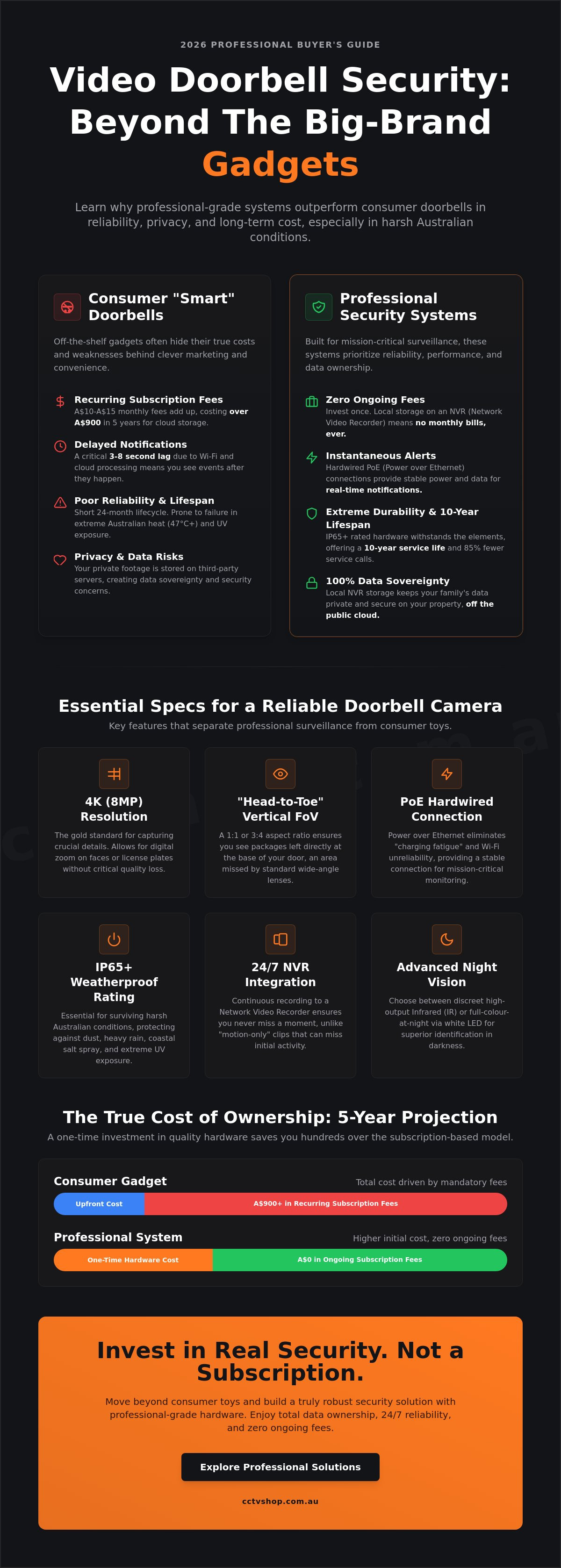
Off-the-shelf gadgets often hide their true cost behind recurring subscription models. A typical A$7 to A$15 monthly fee adds up to over A$900 across five years for just one device. Beyond the financial drain, privacy remains a significant concern since cloud-only models store your private data on third-party servers. Performance also suffers because Wi-Fi-dependent doorbells frequently experience a 3-to-8 second notification lag. This delay means a courier or intruder is often walking away before your smartphone even alerts you to the activity.
Professional Security vs. Smart Home Gadgets
There's a clear distinction between a smart home toy and a professional surveillance tool. While consumer gadgets rely on "motion-only" clips that often miss the first few seconds of an event, professional systems offer 24/7 continuous recording. This ensures you never miss a pre-buffer or a subtle detail that occurs before a motion sensor trips. A Network Video Intercom is the professional alternative to a standard door bell camera, providing a hardwired, high-definition communication system that integrates directly into a home security network for 24/7 reliability. By choosing local storage on a dedicated Network Video Recorder (NVR), you retain 100% ownership of your footage without ongoing fees or bandwidth bottlenecks. Our experience with Australian installations shows that hardwired systems reduce service calls by 85% compared to battery-operated Wi-Fi units.
- Reliability: Hardwired connections eliminate the "battery dead" excuse during critical events.
- Data Sovereignty: Local storage keeps your family's movements off the public cloud.
- Visual Quality: Professional sensors offer superior Wide Dynamic Range (WDR) to handle the glare of the Australian sun.
Essential Specs for a Reliable Door Bell Camera in Australia
Selecting a door bell camera requires looking beyond marketing gloss to the hardware's core performance. While 2MP (1080p) resolution serves as the industry minimum for basic identification, professional-grade 4K (8MP) sensors are the current gold standard. This higher pixel density allows you to zoom in on a visitor's face or a vehicle license plate without losing critical detail. You also need to prioritize a "head-to-toe" vertical field of view. A standard wide-angle lens might capture the street, but a 1:1 or 3:4 aspect ratio ensures you can see packages left directly at the base of your door.
Clear communication depends on noise-cancelling two-way talk. It filters out wind and traffic noise, ensuring you're heard clearly during a delivery or a security event. For night-time visibility, you'll choose between Infrared (IR) for discreet monitoring and LED white light. LED options provide full-colour images in total darkness, which is superior for identifying clothing colours. Security isn't just about the hardware; it's also about software integrity. Recent Consumer Reports' findings on video doorbell security highlight why choosing reputable, vetted brands is vital to prevent unauthorized access to your video feed.
Surviving the Australian Climate
Australian conditions are notoriously harsh on outdoor electronics. You should look for an IP65 rating or higher to ensure the device is dust-tight and protected against heavy rain or coastal salt spray. Heat management is equally critical. In regions where summer temperatures exceed 40°C, inferior cameras often throttle performance or shut down entirely. Professional units use specialized heat sinks and UV-resistant housing to prevent the lens from yellowing or clouding over several years of direct sun exposure.
Advanced Detection Features
Modern systems use AcuSense or WizSense technology to differentiate between humans, vehicles, and irrelevant motion like swaying trees or pets. This reduces false alerts by up to 90% in most residential environments. Facial recognition adds another layer of utility, sending specific alerts when a family member arrives home. By setting customisable motion zones, you can ignore the public footpath and only trigger recordings when someone enters your property. If you're unsure which AI features fit your home, our team can provide expert advice on the latest door bell camera models available in Australian stock.
PoE vs. Wireless: Choosing the Right Connection for Your Entryway
Deciding how your door bell camera connects to your home network is a choice between absolute reliability and installation speed. While wireless models dominate the consumer market, professional security standards often dictate a wired approach to avoid common pitfalls like signal interference and battery maintenance. Your choice determines whether your footage is captured every time or lost to a dropped connection.
Australian homes present unique challenges for wireless signals. Standard double-brick construction and thick render can degrade Wi-Fi strength by as much as 60 percent before the signal even reaches your front gate. Additionally, high-resolution video streams require significant bandwidth. A 4K doorbell stream can consume 8 Mbps of your network capacity. Without a robust connection, you will experience "ghosting" or delayed notifications that defeat the purpose of real-time security.
The Case for PoE Doorbell Cameras
Power over Ethernet (PoE) is the gold standard for mission-critical entry security. This technology uses a single Cat6 cable to provide both a high-speed data connection and electrical power. It eliminates the need for a nearby power outlet or the "charging fatigue" associated with battery units. For Australians building a new home or undertaking a major renovation, PoE is the most logical investment.
A wired connection ensures your system records 24/7 without the two-second "wake-up" lag common in battery-powered devices. It also allows for seamless integration with professional home security cameras and Network Video Recorders (NVRs). This centralises your storage and ensures your front door footage is backed up locally, not just in the cloud.
When to Use Wireless Doorbell Systems
Wireless units are the practical choice for retrofitting older Australian homes where running internal cables is cost-prohibitive. They offer a "plug-and-play" experience that appeals to renters and DIY enthusiasts. To ensure success, you must account for the distance between your router and the entry point. We often recommend installing a dedicated Wi-Fi mesh node within three metres of the front door to maintain a stable 1080p or 2K stream.
If you choose this path, be mindful of battery life. In high-traffic areas, a door bell camera might require charging every eight to twelve weeks. To compare the latest high-endurance models, view our Wireless Security Cameras Comparison. Using a wireless system doesn't mean sacrificing quality, but it does require a more proactive maintenance schedule to ensure the device never goes offline when you need it most.
How to Integrate Your Doorbell into a Professional CCTV System
Standalone apps often isolate your front door from the rest of your security infrastructure. Integrating a professional door bell camera into a centralized Network Video Recorder (NVR) eliminates this fragmentation. It allows you to manage your entry point alongside your perimeter cameras on a single interface. This unified approach ensures you don't waste time switching between different applications during a security event. By connecting your doorbell to an NVR, you move from simple motion alerts to a comprehensive 24/7 recording solution that captures every detail.
NVR and Storage Configuration
Before you begin the installation, verify that your NVR has an available channel for the doorbell. Most modern systems are sold in 4, 8, or 16-channel configurations. If your current unit is at capacity, you'll need to upgrade the recorder to accommodate the additional video stream. High-resolution door bell camera units require significant bandwidth. Referencing our Hikvision NVR Guide will help you determine the correct bitrate settings for your specific model.
Storage is the most critical component of a professional setup. Standard desktop hard drives aren't built for the 24/7 write-load of a security system and will likely fail within 12 months. You must use surveillance-grade HDDs, such as Western Digital Purple or Seagate SkyHawk drives. These are engineered for 90% write cycles and 10% read cycles. This hardware ensures that your front door footage is stored reliably for weeks or months, providing essential evidence if a dispute or incident occurs.
Smart Home Hub Integration
Modern security thrives on connectivity and ease of use. You can stream your live doorbell feed directly to smart screens like the Google Nest Hub or Echo Show. This provides a hands-free view of your front porch from the kitchen or home office. Professional brands use unified platforms like the Hik-Connect or Dahua DMSS apps. These apps allow you to control your entire security ecosystem from one place, rather than managing a dozen different smart home gadgets.
- Automated Triggers: Set your system so that detecting a person after 8:00 PM automatically activates your porch and driveway lights.
- Smart Access: Pair your doorbell with a smart lock to verify a courier's identity and unlock the door remotely through the same interface.
- Unified Alerts: Receive a single notification that includes snapshots from both your doorbell and your nearest overhead CCTV camera for total context.
Security shouldn't create vulnerabilities in your home network. Avoid opening ports on your router to enable remote viewing. Instead, use encrypted P2P (Peer-to-Peer) connections or a dedicated VPN. This keeps your video data private while allowing you to monitor your Australian property from any location. If you want to ensure your setup is both secure and functional, speak with our local technical support team for a tailored integration plan.
Top Professional Door Bell Camera Recommendations for 2026
The landscape for the door bell camera has shifted significantly as we enter 2026. While the Hikvision DS-HD1 was once the industry standard for high-performance residential entry, the market is now led by the next-generation Hikvision DS-KV series and the Dahua DHI-VTO range. These units offer deeper integration with existing security ecosystems compared to standalone consumer brands. Choosing Australian stock is vital for your security investment. It guarantees you receive local technical support and a valid local warranty, ensuring your hardware remains operational without the risks associated with grey-market imports.
Best All-Rounder: Hikvision Professional Series
The latest 4MP Hikvision professional door stations have replaced older 1080p models as the gold standard for residential security. These units feature AcuSense technology, which filters out 90% of false motion alerts by specifically identifying human shapes. This level of precision is a major upgrade for homeowners tired of constant notifications caused by swaying trees or passing pets. These cameras offer seamless compatibility with existing Hikvision systems, allowing you to record doorbell footage directly onto your NVR hard drive for long-term storage. For high-traffic areas or front gates, these models feature an IK08 vandal-resistance rating, which means the chassis can withstand significant physical impact without compromising the internal electronics.
Best for Large Estates: Dahua Intercom Systems
For properties with complex entry points or multi-tenant requirements, Dahua provides a modular approach that consumer brands simply can't match. Their systems allow for custom configurations including keypad modules, fingerprint scanners, and card readers. A standout feature is the native integration with electronic strikes; this allows users to remotely unlock gates or pedestrian doors directly from the mobile app while viewing a live feed. You can explore the Dahua Guide to learn more about how their advanced AI features manage perimeter protection and vehicle recognition on large sites. These systems are designed for high-performance reliability in the harsh Australian climate.
Professional Entry Points and Budget Solutions
If you're looking for a professional-grade door bell camera on a budget, HiLook by Hikvision is the ideal entry point. It provides the same reliable build quality and app stability as the flagship range but at a more accessible price point. It's the perfect choice for standard residential installs where basic high-definition video and two-way audio are the primary requirements without the need for complex modular expansions.
Get Expert Advice
Choosing the right entry security depends on your specific cabling, property layout, and desired level of control. Contact the team at CCTV Shop for a custom recommendation tailored to your home or business. We include free DIY installation guides with every purchase to ensure your setup is professional and secure from day one. Shop our range of Video Doorbells today to secure your property with the best technology 2026 has to offer.
Secure Your Entryway with Professional Clarity
Selecting a door bell camera in 2026 requires looking beyond basic motion alerts to professional-grade features like 4K resolution and seamless NVR integration. Whether you opt for the stability of a PoE connection or the flexibility of high-speed wireless, your choice should prioritize 24/7 recording capabilities over simple cloud snapshots. Industry data indicates that high-definition video surveillance now serves as a primary deterrent in 80% of residential security incidents across Australia. Securing your home means choosing hardware that stands up to local conditions while providing the remote access you need for total visibility.
We're a 100% Australian owned and operated specialist providing genuine Australian stock backed by a full local warranty. You don't have to navigate technical hurdles alone; our expert technical support is available for all DIY installers to ensure your system is configured for maximum security. Upgrade to a Professional Doorbell Camera with CCTV Shop and take control of your property's safety today. Investing in quality hardware ensures your peace of mind remains uninterrupted for years to come.
Frequently Asked Questions
Do I need a subscription to use a professional doorbell camera?
You don't need a monthly subscription if you choose a professional door bell camera designed for local storage. While consumer brands often charge A$5.00 to A$15.00 per month for cloud access, professional systems use an internal microSD card or a Network Video Recorder. This approach gives you full ownership of your footage. It ensures your data stays within your Australian home network without any ongoing financial commitments.
Can I install a PoE doorbell camera myself?
You can physically mount the hardware yourself, but Australian regulations often require a licensed data cabler for permanent structural wiring. A Power over Ethernet setup requires running a Cat6 cable from your NVR or switch to the front door. While the plug-and-play nature of modern systems is user-friendly, hiring a professional ensures the 802.3af power standard is met and the weatherproofing remains intact for long-term reliability.
Will a doorbell camera work with my existing Hikvision or Dahua NVR?
Most professional doorbell cameras will integrate seamlessly with your existing Hikvision or Dahua NVR, provided they support the ONVIF protocol. if you use a matching brand, the NVR treats the doorbell as a standard IP camera. This allows for 24/7 recording rather than just motion clips. This integration is a key advantage of professional-grade hardware, as it centralizes your security management into a single, efficient interface.
How do I prevent my doorbell camera from being stolen?
You prevent theft by using manufacturer-supplied security screws and specialized tamper-resistant mounting brackets. Most high-end units include a built-in tamper alarm that triggers a 90-decibel siren if the device is pried from the wall. Because professional systems record directly to an NVR located safely inside your home, you'll have high-definition footage of the thief even if the physical unit is taken, which assists local law enforcement.
What is the best doorbell camera for a double-storey house with brick walls?
A hardwired PoE door bell camera is the best choice for double-storey Australian homes with double-brick construction. Brick walls can reduce Wi-Fi signal strength by up to 50 percent, leading to delayed notifications or dropped video feeds. By using a physical ethernet connection, you bypass these signal obstacles entirely. This ensures a stable 4K stream and instantaneous two-way talk, regardless of your router's location on the second floor.
Can I unlock my front door through the doorbell camera app?
You can unlock your door through the app if your doorbell is integrated with a compatible electronic strike or smart lock. Professional systems often feature a built-in relay output that connects directly to your door hardware. When a visitor presses the button, you verify their identity via the video feed and trigger the lock release with a single tap. This provides a secure and convenient access control solution for your home.
What happens if my Wi-Fi goes down? Does the camera still record?
Your camera will continue to record if it's connected to a local NVR or has an internal microSD card installed. While Wi-Fi-only models lose cloud connectivity during an internet outage, professional hardwired systems operate on your local area network. This means your security remains active 100 percent of the time. You won't receive mobile alerts until the internet returns, but the critical footage is safely stored on your local hardware.
How much data does a 4K doorbell camera use on my home network?
A 4K camera typically uses between 2 and 4 Mbps of upload bandwidth when you're viewing the live stream remotely. However, it uses zero internet data when recording to a local NVR or microSD card. If you're on a limited Australian NBN plan, using H.265 compression can reduce data consumption by up to 50 percent. This ensures high-quality video without congesting your home network or exceeding your data limits.